
Mr. Irrelevant
Two hundred and sixty-two players got drafted to the NFL in April 2022. The last one was a quarterback from Iowa State whose draft profile read "limited arm strength, average athleticism, unlikely to develop into a starter." His name was Brock Purdy.
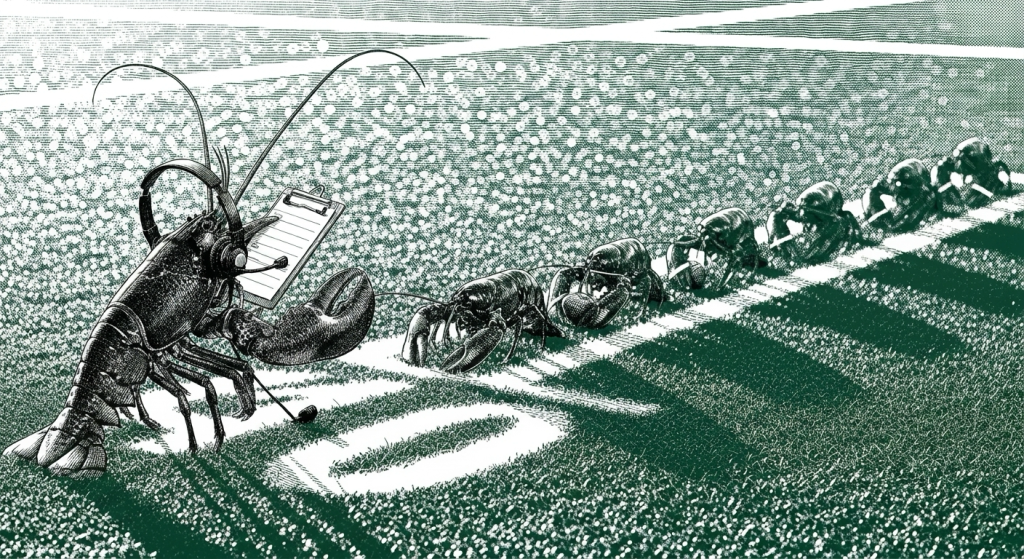
By Christmas of his rookie year he was leading the San Francisco 49ers to the NFC Championship game. By 2024 he was a Pro Bowler. The scouting model had missed him by 261 picks. Corporate America is running the same scouting model on its own employees this week — same drills, same stopwatch, same broken Wunderlic — and cutting its Brock Purdys for being too productive. The Pope opened his encyclical with a warning about vigilance two days ago. Anthropic shipped the toolkit for it yesterday. The other two layers of the AI-forward operating system are still in your building, and the scouting report you’re using to staff them is from 1970.
THE NUMBER: 262 — the pick number at which the San Francisco 49ers selected Brock Purdy out of Iowa State on April 30, 2022. The 262nd pick of the seventh and final round of the NFL Draft is, by tradition, given a ceremonial title — Mr. Irrelevant — and a weeklong celebration in Newport Beach culminating in the Lowsman Trophy, a piece of hardware showing a player fumbling a football. The joke is the point. The 262nd pick is the player no one expects to make the team, never mind the league, never mind the depth chart. By December of his rookie season, Purdy was the 49ers’ starting quarterback after Trey Lance — the third overall pick of the 2021 draft, on whom the team had traded away three future first-round picks — went down with a season-ending injury, and Jimmy Garoppolo — the $137-million-dollar man — followed two months later with a broken foot. Purdy started. The 49ers won eight games in a row. He took them to the NFC Championship Game. The 262nd pick of the draft was, by January, the most valuable quarterback in the conference. The scouting model the league had spent fifty-six years calibrating — the 40-yard dash, the bench press, the Wonderlic, the cone drill, the vertical leap, the Combine — had missed him by two hundred and sixty-one picks. Not by one. Not by ten. By the length of the entire seven-round draft. The same week the 49ers were riding Purdy through the playoffs, every other front office in the league was running the same drills on the same kind of kid and missing the same kind of player. The system was not broken on the margin. The system was broken structurally. This morning, in nine out of every ten offices in corporate America, the same kind of system is being run on the people who will or will not produce the next decade of compounding output from a generative AI deployment. The 40-yard dashes are token-usage dashboards. The bench press is headcount-of-direct-reports. The Wonderlic is the quarterly engagement survey. And the Brock Purdys of the AI age are being cut for being too efficient.
The 1970 Combine
The NFL Scouting Combine was institutionalized in 1982, but the drills it canonized had been developed and refined inside individual franchises across the 1960s and 1970s. The premise was straightforward: a great athlete should be measurable. Speed could be timed. Strength could be loaded. Cognition could be tested. Agility could be cone-drilled. Vertical explosion could be jumped. The thing the scouts could not see — the intangible — could be triangulated by the things they could.
The drills worked. Or, more precisely, the drills worked in a league that ran the I-formation, threw the ball maybe twenty-five times a game, and asked its quarterbacks to drop seven steps and unload a vertical strike to a flanker running a comeback at fifteen yards. The 40-yard dash predicted who could outrun a linebacker in the open field. The bench press predicted who could anchor against the bull rush. The Wonderlic — twelve minutes, fifty questions, first deployed by Tom Landry in 1968 — was a proxy for whether a quarterback could read the man-coverage defenses of the era inside the play clock. The drills predicted the game that was being played.
Then Bill Walsh joined the 49ers in 1979, ran the West Coast offense on the league for a decade, and the game changed. By the mid-1990s, NFL offenses were throwing forty times a game on short, timing-based concepts that demanded anticipation rather than arm strength. Bill Belichick joined the Patriots in 2000, took a sixth-round quarterback whose Combine performance was a documented disaster — Tom Brady ran a 5.28 forty, did twenty-four reps on the bench press, and scored a 33 on the Wonderlic but tested poorly on the agility cones — and turned him into the greatest quarterback in football history. The Combine had Brady ranked behind Chad Pennington, Giovanni Carmazzi, Chris Redman, Tee Martin, Marc Bulger, and Spergon Wynn. The Combine was catastrophically wrong about Brady. And in the twenty-five years since, the Combine has not meaningfully changed the drills it gives its quarterbacks.
That is the part that should make every executive’s neck hurt. Not that the model was wrong about Brady. Models are wrong about individuals all the time. The model was wrong, structurally, about the game itself. The drills measured the 1970 quarterback. The game by 2000 was being played by a 2000 quarterback. The model didn’t catch up. It still hasn’t. The 40-yard dash and the bench press are still the Combine’s two most-televised drills. They predict almost nothing in the modern league. They were never updated because the infrastructure of the Combine — the scouts, the stopwatches, the booklets, the publicly-released composite scores, the careers of the people who run it — was built around the old measurements. To change the measurement is to change the careers. No one in the building had the incentive.
Brock Purdy is the proof that the model is still broken twenty-six years after Brady. The Iowa State quarterback who lasted to pick 262 had — by every account of the pre-draft scouting reports — average arm strength, average athleticism, and a “limited ceiling.” What he had instead was processing speed. He read defenses inside the snap count. He moved the protection. He found the back-shoulder throw to the slot. He was, in modern football terms, a coach’s son with a quarterback’s brain in a body the Combine couldn’t be bothered to value. Twenty-five years after Brady, the Combine missed the next one by the same margin and in the same direction. The drills had not been updated. The careers in the building were still pegged to the old drills. The Brock Purdys of the 2022 draft class fell to pick 262 because there was no incentive for anyone in the front office to acknowledge that the Combine’s headline drills had become cultural artifacts rather than predictive instruments.
This is the structural condition that every Fortune 500 executive is now running, in their own building, against their own people, on the question of who is and is not an AI-forward employee. And almost nobody has noticed.
The Token Dashboard Is a 40-Yard Dash
Spend a week inside any large enterprise’s AI program-management dashboard and the metric you will see, displayed prominently, color-coded, ranked by employee, broken out by quarter, is tokens consumed.
It is a 40-yard dash.
It measures the wrong thing in two distinct ways. First, it is a measure of input, not output. A token is a unit of model consumption. Consuming more tokens does not, by itself, produce more useful work. A heavy token user could be the most productive engineer in the building. They could also be the engineer who has built six elaborate auto-loops that re-summarize the same Slack channel every fifteen minutes for no reason. The token dashboard cannot tell the difference. It is, in football terms, a body-fat scale: it tells you about a thing the player is, not about a thing the player can do.
Second — and this is the part that compounds — the token dashboard creates the behavior it measures. Last summer, Uber installed internal leaderboards ranking engineers by how many tokens they spent in Claude Code. The leaderboard was, in the CTO’s words, supposed to drive adoption. Adoption went from thirty-two percent to eighty-four percent in four months. The 2026 AI budget was blown by April (per The Information). And — here is the part the company has not yet publicly admitted — the engineers who topped the leaderboard were not the same engineers who produced the heaviest commit-volume in the same period. They were the engineers who had figured out that the measurement was the path to status, and had reverse-engineered the metric. They were the people gaming the Combine. The actual Brock Purdys at Uber were several rows below them on the leaderboard, doing roughly twenty percent of the token-burn and forty percent of the work.
The same pattern showed up at Microsoft two weeks ago. The same one showed up at the Fortune 50 company whose employee — your Verstappen, the person whose learn-fix-rerun cycle was twenty percent tighter than every engineer in the building — got her token allocation rationed because her usage was anomalously high. The token dashboard didn’t find the Verstappen. It cut her. It ran her through a 40-yard dash and asked her to slow down because she was making the rest of the draft class look bad.
Every one of these companies still has a token dashboard. Most of them are reading higher in the C-suite this quarter than last quarter, because the discipline of “watching spend” is exactly the kind of measurable accountability that boards reward. And every one of them is currently running the 1970 Combine on its own workforce.
The headcount-prominence org chart is the bench press. For thirty years, the easiest way to demonstrate executive significance inside a Fortune 500 was the number of humans who reported to you. The director had three. The senior director had eight. The VP had twenty-eight. The SVP had a department. The EVP had two departments. Compensation tracked it. Title tracked it. The seating chart tracked it. The size of the office tracked it. The performance review system was designed around the assumption that managing more humans was harder than managing fewer humans, which was roughly true in the era when humans were the most leveraged unit of work. It is no longer true. Managing a fleet of twelve agents in 2026 is harder, more sophisticated, and worth more to the company than managing a team of twelve junior analysts. The bench press still tells you who can move the heaviest weight. It no longer tells you who can play.
The quarterly engagement survey is the Wonderlic. The shape of corporate cognition has moved past the multiple-choice test of “are you a satisfied employee on the dimensions we have decided to measure.” The thing that produces compounding output now is something the engagement survey cannot detect: can this person diagnose what an agent did wrong and write a better prompt before lunch? The Wonderlic asks if numbers are bigger than other numbers. The actual game asks if you can read the polysemantic neurons firing in the model you just deployed and figure out which feature you accidentally activated. Different test.
This is the part the most aggressive operators in the country are still missing. They have built the AI program on top of a measurement infrastructure that predates the game. The Combine has not been redesigned. The drills are still being run. The Brock Purdys are being cut. The grunters and the gamers are getting promoted. And the bill — when it lands — will look exactly like the hundred thousand technology-sector layoffs that have already moved through the first five months of this year, except that the next hundred thousand will be cut on metrics nobody in the building can yet name.
The job in front of every CEO, every CTO, every Chief Human Resources Officer reading this newsletter is to redesign the Combine, in their building, in 2026, before the next round of cuts. The labs are not going to do that work for them.
The labs are doing the work underneath it.
Three Layers, One Buyable
What an AI-forward company looks like is not yet a settled question. It is, however, becoming a structured one. The architecture has three layers, and the three layers have three different owners, and as of this week one of the three layers has a shippable product.
Layer One: Agent-Level Safety. This is the work of containing what a single agent can do inside a single workflow. It is the engineering question that Anthropic’s research blog — the How We Contain Claude Across Products essay published Monday, May 25 — laid out in working detail. The framework is two-part. The first is human-in-the-loop supervision: the agent asks permission before it acts. The second is constrain the environment: the agent operates in a sandbox whose walls are the actual limit, not the agent’s discretion. Anthropic shipped the essay because they had the receipts. They had also, by their own published telemetry, demonstrated that the first method — the permission prompt — was a failure mode at scale. Claude Code users were approving ninety-three percent of permission prompts. Two of the three approvals were happening without inspection. The human in the loop was a checkbox the human had learned to click. The honest finding inside the essay is that the second method — environmental containment, blast-radius limitation, capability gating — is now the only one that scales. The essay names a concrete instance: Claude Mythos Preview, Anthropic’s next-generation agent, was held back from release in April 2026 because its blast radius “was deemed too high to ship.” The model exists. The model works. The model is not being shipped because the containment infrastructure around it has not yet matured. The lab made the call. The lab made it on the basis of an internal framework that, until this week, had not been public. Agent-level safety, in operational terms, is the discipline of refusing to release a capability your sandbox cannot yet hold. That is engineering. That is the bottom layer.
Layer Two: Corporate-Level Safety. This is the work of governing what the organization deploying the agent can do with it, across users, across teams, across systems, across regulatory perimeters. It is the layer that asks who has access, to what, under what audit, with what billing, with what observability, with what fail-stop. It is not engineering. It is policy. It is the layer that — until very recently — was being staffed by IT generalists and a Chief Information Security Officer who had never personally watched an agent run for ten minutes inside their own enterprise. It is also, structurally, the layer that the Magnifica Humanitas encyclical was aimed at. The Pope’s seven words — AI is a valuable tool that requires vigilance — read, on second reading, as a job description for an officer of the corporation. The vigilance is corporate. The accountability is corporate. The audit trail is corporate. The Pope wrote a memo to the board.
Layer Three: Technology-Level Safety. This is the work of making the model itself legible to corporate-level safety — of producing the instruments by which the corporate officer can do their vigilance. It is the layer Anthropic’s Christopher Olah has built his entire career on. It is the Circuits work. It is feature attribution. It is the Claude Compliance API — the conversation-content stream, the activity-event stream, the programmatic surface that lets an enterprise security operations center see what the model and its users were doing in audit-grade detail. And it is the twenty-eight security and compliance platforms — CrowdStrike, Palo Alto, Okta, Datadog, Cloudflare, Microsoft, IBM, Zscaler, Wiz, Snyk, Proofpoint, Rubrik, Tenable, and fourteen others — with which Anthropic announced last week that Claude Enterprise now integrates natively. The list reads like a bill of materials for an enterprise SOC. That is the point. Anthropic is not asking the SOC to learn how to monitor an AI agent. Anthropic is shipping the AI agent into the monitoring infrastructure the SOC already runs. That is what shipping the technology layer looks like.
The three layers have three different owners. Agent-level safety belongs to your engineering team. They write the prompts, they constrain the environment, they decide when not to ship the capability. Corporate-level safety belongs to your CIO and your board. They write the policy, they audit the deployment, they fire the executive whose AI agent leaked the data. Technology-level safety belongs to the lab. And as of this week — only this week — the lab has shipped a product. You can buy it. You can wire it. You can put it on the procurement schedule next quarter. It will not solve the layers above it. It will, however, give the layers above it the instruments they need.
The other frontier labs do not, as of this morning, have a comparable framework on the public record. OpenAI has the Codex brand, the Enterprise tier, the SOC 2 Type II attestations. They do not have a containment essay. They do not have a publicly held-back model. They do not have a twenty-eight-integration list with the same enterprise-security depth. They will, eventually, ship something analogous — they have the engineers and the budget and the customer demand. They have not shipped it yet. The same is true of Google DeepMind and of xAI. The layer-three product space, this week, is a one-lab category. That is what category capture looks like.
The Tom Tunguz piece that landed this week — “Agent Gravity: Who’s Running Your Agents” — names the corollary explicitly. Whichever lab pulls your agents into its observability orbit, gains a structural advantage that compounds. The 28-integration list is the gravity well. The Compliance API is the orbital lock. The held-back Mythos model is the credibility deposit that says this lab takes the layer seriously enough to leave money on the table. Three pieces. One bid. They are bidding to be the operating system of corporate-level AI deployment. They might win it.
Offense, Defense, And The Half Of The Org Chart Nobody Is Funding
Inside an AI-forward operating model, the spend splits two ways. The honest version of the budget conversation that almost no board is currently having out loud sounds like this:
Offense. AI that grows the top line. AI that books a meeting that would not have been booked. AI that writes the email that closes the deal. AI that builds the feature that ships the product that retains the customer. AI that finds the lead, qualifies the lead, hands the lead to the human at the moment of maximum conversion. Look at the scored deep-source piece in today’s research about Owner.com — Adam Guild’s restaurant-software company — whose Chief Revenue Officer is closing two million dollars in annual recurring revenue per rep by wiring AI-driven prospect research, call-summary, and deal-progression into every step of the sales motion. Two million dollars per rep is not a software number. It is a private-equity number. It is the kind of unit economics the entire SaaS category was supposed to converge on by 2030 and that almost no company has actually achieved. Owner has achieved it because they redesigned the sales function — not because they bought a tool. The agent is the rep’s exoskeleton. The rep is the agent’s customer-empathy module. Together they do the work of three. That is offense.
Defense. AI that protects the moat. AI that detects the anomaly in the access log. AI that flags the policy-violating prompt. AI that audits the model’s output for PII leakage. AI that watches the watchers — the SOC analyst who is now monitoring an agent rather than monitoring a human, the compliance officer whose new dashboard is the Claude Compliance API, the legal team whose Relativity e-discovery system is now ingesting Claude conversation logs the same way it ingests email. Defense is the half of the AI program-management dashboard that almost nobody is funding right now — because the offense numbers move faster, the offense ROI is easier to model, and the defense team has historically been the people you bring in after the breach to clean up. The 28-integration play that Anthropic shipped this week is the first commercial-grade defensive AI deployment kit. Most enterprises don’t have a budget line for it yet. They will, by Q4. The labs are building the rails on the assumption that the customer will eventually have to use them. They are right.
The ratio is wrong in almost every company we have talked to this month. Most enterprises are spending eighty percent of the AI budget on offense — sales agents, marketing agents, dev-velocity agents, customer-service agents — and twenty percent on defense. The right ratio, by the end of next year, is closer to sixty-forty, and at heavily regulated companies (banking, healthcare, defense, insurance) it is probably fifty-fifty. The companies that under-fund defense in 2026 will spend the back half of 2027 explaining to regulators why an agent inside their building exfiltrated a customer database. That is not a hypothetical. That is a press release that has already been written and is sitting in a folder at the FTC waiting for the first trigger event. The trigger event is coming.
The cocktail-party question, for every reader of this newsletter who runs a P&L: what percentage of your current AI spend is offense, and what percentage is defense? If you do not know, neither does anyone in your building, and that is the answer. The next budget cycle is the time to put a number on the ratio. The cycle after that is the time to be embarrassed about it.
Agents Of Note
Here is where the org chart breaks.
For the past forty years, the architecture of corporate prominence has been built on the same load-bearing assumption: the more humans report to you, the more important you are. The director has three. The senior director has eight. The VP has twenty-eight. The SVP runs a department. The EVP runs two. Compensation is pegged to the count. Title is pegged to the count. Office size is pegged to the count. The implicit message of every Monday-morning staff meeting in every Fortune 500 building for forty years has been: I matter because I have humans.
That message was correct when humans were the most leveraged unit of work. The hardest thing in a 1985 corporation was getting twenty humans to do the same thing well. The senior director who could do that deserved the senior-director’s compensation. The compensation tracked the difficulty. The difficulty tracked the unit of leverage.
The unit of leverage moved. Today, in any company with a serious AI deployment, the hardest thing is not getting twenty humans aligned. The hardest thing is getting twenty agents aligned — and figuring out which two humans, in the building, are capable of orchestrating them at the level the work requires. The number of humans reporting to the orchestrator is not the indicator. The orchestrator might have zero direct human reports. They might be a senior staff engineer with no formal management responsibility, an operations analyst who hasn’t been promoted in three years, an IT admin who plays a great deal of Factorio on weekends. The number you actually want is the number of high-quality agents reporting through them and the output the fleet generates.
The pivot from humans of note to agents of note is the structural change every promotion committee in America is about to have to absorb. The current performance-review system cannot see it. The current compensation band system cannot price it. The current title hierarchy cannot accommodate it. Director of Agents is not a title that exists. Neither is VP of Agent Operations or Chief Orchestration Officer. It will be, in the most aggressive companies, by Q4. In the rest, it will arrive late, the way Chief Data Officer arrived late in 2014, and Chief Digital Officer arrived late in 2010, and Chief Customer Officer arrived late in 2005. The org chart always catches up to the unit of leverage. It just catches up after the leverage has been visible to the operators for two or three years.
The companies that are catching up now — ClickUp under Zeb Evans, whose 100X organization playbook we covered in Emmet’s Roof — are doing it by stripping the headcount layer of management entirely. The middle that exists to coordinate humans is being cut because the humans being coordinated are being replaced by agents that don’t need coordinating in the same way. The middle that exists to coordinate the agents is being newly hired, often in a different role, often at a different comp band, often reporting to the founder directly. The org chart isn’t just compressing. It is rotating. The axis it used to be drawn around — managerial span of control — is being replaced by a new axis: orchestration leverage per orchestrator.
This is what the Brock Purdy story does inside a corporation. The 262nd pick of the AI-forward draft is the person nobody currently sees on their depth chart. They are running heavy AI usage on a personal license. They are building elaborate private toolchains. They are getting their work done faster than the people around them and have, in most cases, stopped advertising the fact because the previous time they advertised it the response from middle management was to ration the tokens. They are sitting under the surface. They are waiting. They will, in eighteen months, either be running your agent fleet or be running someone else’s.
The teams that win the decade will be the teams whose front office is rebuilding the Combine right now, in 2026, on the bet that the people who pass the new drills are the ones who will produce the next ten years of compounding output. That redesign is not a project the labs are going to do for you. The labs are shipping the technology layer. The corporate layer is yours. The Combine is yours.
What You Do, Tuesday
The operating implication has four parts and one warning. None of them are theoretical.
One. Read the Anthropic containment essay this week. Have your CTO read it. Have your CISO read it. Have your board’s audit-committee chair read it. Then have all three of them answer one question on the same page: what does our equivalent framework look like? Most companies do not have a written equivalent. The absence of one will become a competitive tell — and a regulatory tell — by Q4. The companies that do publish one are not doing it because they have figured out AI safety. They are doing it because they have figured out that the act of publishing the framework is itself a moat. It signals to customers, regulators, employees, and the board that the company has thought through what it is doing. The companies that don’t publish one will look, by comparison, like the people who didn’t have a GDPR policy in 2017.
Two. Stop ranking employees by token consumption. Start measuring useful output per token. This is the operational version of the Combine redesign. The dashboard you have right now is measuring the 40-yard dash. The dashboard you need is measuring yards per attempt on third down. It is a harder dashboard to build. It requires actually looking at the work product. It requires actually evaluating whether the work product was better than the work product would have been without the AI. It will surface a different list of names than the current one. It will surface, specifically, the Brock Purdys — the people whose token-to-output ratio is twenty percent of the average and whose work-quality-to-output ratio is two hundred percent of the average. Promote them. Protect them. Pay them.
Three. Split your AI budget into Offense and Defense and put the ratio on the next board deck. If the number is eighty-twenty, that is a finding. The board will ask why. The CFO will have an answer. The answer will be a project plan. The project plan will rebalance the ratio. This is not about being defensive. This is about not being the company whose customer data leaks because the agent that ran on Tuesday had no SOC monitoring on Thursday. The Anthropic 28-integration play exists because there is demand for it. The demand is real. Companies that wait until they have to build it themselves will pay several times what it would have cost them to buy.
Four. Hire your first orchestrator. This is the role nobody has on a current org chart and everybody will have on the 2027 org chart. The orchestrator is a person, usually a senior IC, whose job is the fleet. They tune the agents. They write the meta-prompts. They build the eval harnesses. They watch the dashboards. They are accountable for the output of an agent population the same way a senior director used to be accountable for the output of a human team. Their direct reports are the agents. Their compensation should match what the senior director used to make. Their seat in the room — at the senior staff meeting, on the operating-review committee, at the board-meeting prep — should be a peer seat to the VPs whose teams are now smaller than the orchestrator’s fleet. They are the new VP. They just don’t have the title yet.
The warning. The Combine redesign is not a project you delegate to the consulting firm. The consulting firm sells the old Combine. That is, structurally, their business model — they are the people who institutionalized the Wonderlic and the bench-press cards and the cone drills and the long-form personality inventory in your last engagement survey. They cannot redesign the Combine because they are the Combine. The redesign has to be done inside the building, by the operators, in conversation with the engineers, in collaboration with the orchestrators, and with the explicit air-cover of the founder or the CEO. If you’re outsourcing it, you’re not doing it.
The Lowsman Trophy
The trophy they give to Mr. Irrelevant in Newport Beach every June is a small bronze figure of a player fumbling a football. The figure is the joke. The week is the joke. The whole tradition is the league laughing at itself for having sorted, with such enormous expense and ceremony, two hundred and sixty-two players into a draft order that is, by Week Eight of the regular season, completely irrelevant to who is actually playing the game.
The 49ers gave Brock Purdy his Lowsman Trophy in 2022. He posed with it. He smiled. He went to camp.
Five months later he was the most valuable quarterback in the conference. The trophy is still on a shelf in his house in San Jose. The 49ers paid him a five-year, $265 million contract extension last summer that made him, at twenty-five, one of the ten highest-paid players in the league. The bench-press card he filed at the Combine in February 2022 is in a file cabinet somewhere in Indianapolis. Nobody has looked at it since.
The same scene is going to play out across corporate America for the next three years. The people the current Combine misses will, one by one, end up running the agent fleets. The metrics will be redesigned, the org chart will rotate, the orchestrators will be hired, the offense-defense ratio will rebalance, and the consulting firms that built the old Combine will discover that the engagement was non-renewable. It will look fast when it happens. It always looks fast. It is, in fact, slow — it has been building since the first day someone in a building you have heard of figured out that the work could be done differently and stopped advertising it.
The Pope said, on Monday, that AI is a tool that requires vigilance. Anthropic, the next day, shipped the operational toolkit for it. Both of those moves were the outside layers of the system. The inside of the system — the corporate layer, the org chart, the Combine, the people — is your work. Nobody is going to do it for you. The lab cannot. The Pope cannot. The consulting firm sells the old Combine. The board reads about it in a deck six months after the cycle closes.
You have the people. You have the budget. You have the tools the lab just shipped. You have, structurally, every piece you need. What you do not have is the inventory of who in your building is the Brock Purdy and who is the Combine warm-up tape. Run the inventory. Promote the Purdys. Hire the orchestrators. Split the budget. Publish the doctrine. Redesign the Combine.
The next decade of compounding corporate output will be produced by the companies whose front office is doing this work in 2026. The companies that are still ranking employees by tokens consumed and managers by humans reported-to will spend that same decade explaining to their boards why their AI program “didn’t deliver.” It will deliver. It will just deliver to the company across the street.
Don’t run the Combine. Redesign it.
Past Briefings
I Know Kung Fu and AI
THE NUMBER: 11 — the seconds your doctor listens before interrupting you, on average. In 1984 the number was eighteen, so we've spent forty years getting worse at the one thing we keep insisting machines can't do. The thing American medicine ran out of is the thing the machine has in unlimited supply. The catch is that it only hands it over if you know to ask. Tank jacks the disk in. Trinity has to fly a military helicopter she has never touched. "Can you fly that thing?" "Not yet." A phone call, a few seconds of upload, and she...
May 27, 2026Magnifica Humanitas
One hundred and thirty-five years ago this month, an Italian pope signed a letter about the Industrial Revolution that reshaped a century of labor doctrine. Eleven days ago — the same day on the calendar — an American pope signed its sequel about the AI revolution. Yesterday at the Vatican, he released it to the world with the co-founder of Anthropic standing next to him at the lectern. THE NUMBER: 135 — the years between May 15, 1891, when Pope Leo XIII signed Rerum Novarum — Latin for of new things — and reshaped a century of Catholic teaching on...
May 22, 2026Emmet’s Roof
THE NUMBER: 222 — the years between the morning of July 11, 1804, when Aaron Burr shot Alexander Hamilton on the dueling grounds at Weehawken, and the May afternoon I sat in a stripped conference room on the 32nd floor of 120 Broadway signing a loan refinancing with a wet pen, a marble bust watching me from a shelf in the corner. Hamilton's chair — most influential lawyer in New York, founder of The Bank of New York, architect of the United States financial system — stayed empty for five months after the duel. In November 1804 an exiled Irish...