
Magnifica Humanitas
The Church lost the printing press to the Reformation, the university to the Enlightenment, the broadcast tower to the network executives, and the internet to the technologists. They might not lose this one. The handshake is the news. Whose hands are on the wheel is the bigger news.
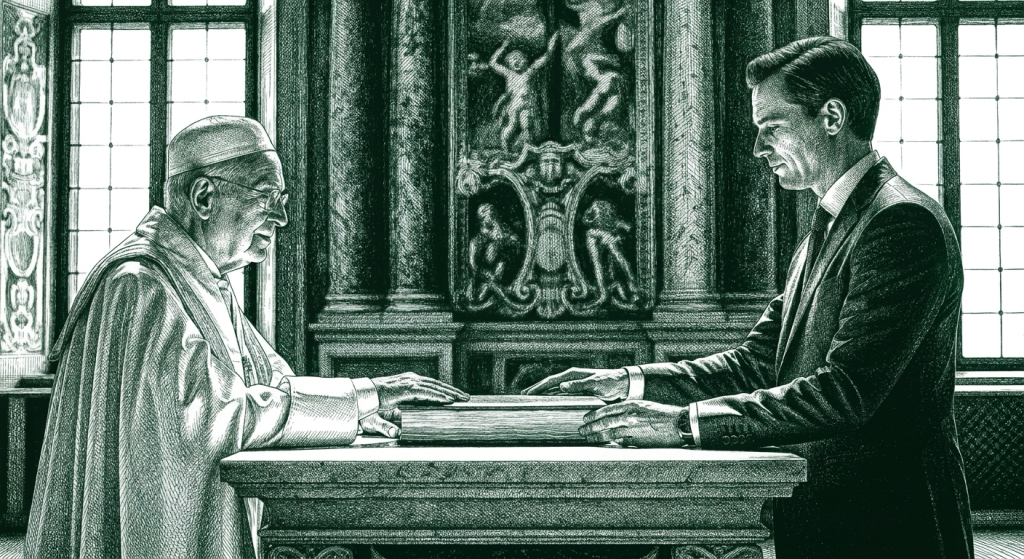
One hundred and thirty-five years ago this month, an Italian pope signed a letter about the Industrial Revolution that reshaped a century of labor doctrine. Eleven days ago — the same day on the calendar — an American pope signed its sequel about the AI revolution. Yesterday at the Vatican, he released it to the world with the co-founder of Anthropic standing next to him at the lectern.
THE NUMBER: 135 — the years between May 15, 1891, when Pope Leo XIII signed Rerum Novarum — Latin for of new things — and reshaped a century of Catholic teaching on labor, capital, and the dignity of the worker during the Industrial Revolution, and May 15, 2026, when Pope Leo XIV — the first American pope, the man who chose his papal name in deliberate reference to his predecessor — signed Magnifica Humanitas: On Safeguarding the Human Person in the Time of Artificial Intelligence. Exactly to the day. Forty-two thousand three hundred words. Then yesterday morning, at the Vatican, he released it to the world — and standing beside him at the lectern was Christopher Olah, co-founder of Anthropic and the AI researcher whose entire career has been about making the black box of large language models legible to human inspection. That is not a photo op. It is a sentence delivered in two parts — one in Latin and one in compute. The Pope’s part: AI is a valuable tool that requires vigilance. Olah’s part: we are building the instruments by which the vigilance becomes possible. Whoever ends up owning the next dominant medium of moral conversation owns the conversation itself. The Church lost that medium four times in five hundred years. They have decided not to lose it a fifth.
A Valuable Tool That Requires Vigilance
The phrase is the Pope’s. It is the title of the first sub-section of Chapter Three of Magnifica Humanitas — the chapter the Vatican titled, in the table of contents the document leads with, “Technology and Dominance: The Grandeur of Humanity in Light of the Promises of AI.” Pope Leo XIV puts the title of the section in lowercase as the answer to the title of the chapter. AI is a valuable tool that requires vigilance. Seven words. He could have stopped there. The other forty-two thousand two hundred and ninety-three are an unpacking of those seven.
The unpacking matters. So does the framing. The Pope did not say AI is a threat. He did not say AI is salvation. He did not say it is morally neutral. He said it is a tool — and then immediately reframed the question. The question with a tool is never what does the tool do. The question with a tool is what does the person holding it do. That is the question Catholic social doctrine has been asking for one hundred and thirty-five years about every successive industrial technology, going back to the steam loom. Rerum Novarum in 1891 was a meditation on the steam loom and the factory floor. Magnifica Humanitas in 2026 is the same meditation aimed at the API and the prompt window. Different machine. Same question.
I want to put the metaphor in concrete terms because the readers of this newsletter are operators, not theologians, and operators think in tools they have actually held.
Put me behind the wheel of a Porsche 911 GT3 on the highway. I will drive faster than I do in my own car. I will probably get from point A to point B more quickly. I have a license, I have broken the speed limit, I have some idea what the paddle shifters are for. The car is a tool. I am a person. The tool will make me a slightly faster driver. Put Max Verstappen — current four-time Formula 1 World Champion and arguably the best driver alive — behind the same wheel on the same stretch of road, and the same tool will produce a fundamentally different output. He will not get to point B fifteen percent faster than I would. He will get there in a way that redefines what point B means. He will arrive having extracted things from the car that I did not know the car could give. That is what a tool does in expert hands. It stops being a tool. It becomes a translation.
Now reverse the experiment. Put Michael Jordan on a minor-league baseball field in 1994. The greatest basketball player of all time. A man whose hand-eye coordination, athletic ceiling, and competitive fire were the standard against which an entire generation of athletes measured themselves. He spent one and a half seasons in the Chicago White Sox organization. He hit .202 against double-A pitching. He was, by every account, a journeyman in a different sport, in a tool he did not know how to hold. The tool does not transfer. Jordan-the-GOAT in basketball was a slightly-below-average player in baseball. Verstappen-the-GOAT in F1 would not, dropped onto a tennis court tomorrow, beat the world number eighty. The skill is not in the human and it is not in the tool. It is in the match — the specific compatibility of one to the other.
This is where every Fortune 500 currently making AI decisions is getting the question wrong.
The Diagnostic Loop
Watch a Grand Prix qualifying session sometime and pay attention to what Verstappen does between laps. He does not drive the same lap twice. He pits, he climbs out, he sits with the engineers, he describes what the car did at turn six — the understeer started before the apex, the rears went away on exit, the brake pedal got long in the chicane. The engineers adjust. He goes back out. He drives a different lap. He reports again. The car gets tuned. The lap time comes down. The compounding is in the diagnostic loop, not in any single lap.
That is the actual edge. Not raw speed. The slope of the improvement curve. A driver who can hold the car at ten-tenths but cannot describe what the car is doing underneath him will never become a champion, because the engineering team cannot improve a car they cannot diagnose. The thing that makes Verstappen Verstappen — the thing that makes Lewis Hamilton Hamilton, that made Senna Senna, that made Schumacher Schumacher — is the quality of the feedback loop between the human and the machine. He drives. He describes. The team tunes. He drives the new configuration. He describes again. The team tunes again. By the time the race starts, the car the field is chasing is not the car he qualified — it is the car he diagnosed his way into.
This is what the agentic-computing GOAT looks like in your office, and almost no executive in America has figured out how to test for it.
The GOAT of agentic AI is not the engineer with the highest Claude Code usage count. It is not the manager who burns the most tokens in a quarter. It is not the analyst whose LLM observability dashboard shows the most spans. It is the person who can finish a task with AI, look at the output, identify exactly what went wrong and why, write a better prompt or build a better workflow on the next pass, and get the result twenty percent better — and then do that again, four hours later, on a different problem, and get that result twenty percent better. They run the tightest learn-fix-rerun cycle in your building. The lap times come down. The compounding is the edge.
The most uncomfortable part of this — for every middle manager reading — is that you cannot tell who has this skill by looking at their resume. It might be the senior staff engineer with twenty years of experience. It might be the new hire two years out of college. It might, very plausibly, be the operations analyst who has been quietly using Cursor on her own time for eighteen months and has built a private library of prompts that her boss has never seen. It might be the IT admin who plays a great deal of Factorio on weekends and turns out to think about system optimization at a level no one in the room has. You don’t know. Your HR system does not know. Your performance review process does not know. You will have to test for it, and you will have to test for the right thing, which is the slope of the improvement curve and not the height of the usage column.
Almost nobody is testing for the slope. Almost everybody is testing for the column.
The Wrong Experiment
This is what made the past two weeks of corporate AI news so structurally embarrassing.
Start with Microsoft. The company that put thirteen billion dollars into OpenAI — much of it as Azure compute commitments rather than cash. The company whose Azure infrastructure powers a meaningful share of Anthropic’s compute. A company that, last November, wrote a separate $5 billion equity check into Anthropic on the same day Anthropic agreed to spend $30 billion right back on Azure compute — six dollars of cloud revenue inked against every dollar of equity, the round-trip flavor of capital that Wall Street has been quietly anxious about all year. And then, six months ago, the same company handed out Claude Code licenses to roughly one hundred thousand of its own engineers and said go forth and ship. Adoption exploded. Engineers loved it. The internal Slack channels filled with the kind of giddy testimonials product managers spend their careers trying to manufacture. By April, the invoices started landing on the desk of Microsoft’s CFO.
Token-based pricing scales with use. The engineers were using a lot. The numbers got large. By the end of last week, Microsoft had issued an internal order: cancel substantially all Claude Code licenses by the end of June and migrate the engineering organization onto its own less expensive alternative. The same company that invested ten billion dollars to make Anthropic exist just told its own people to stop using Anthropic’s product because it costs too much. That is not a productivity failure on Anthropic’s side. That is a measurement failure on Microsoft’s side. The CFO measured the number that landed on his desk. He did not measure the number that mattered, which is the slope of the engineering organization’s productivity curve over the quarter that the licenses were active. The wrong number was the easier number. He chose it.
Uber ran the same experiment with a more elaborate scoring system and the same result. CTO Praveen Neppalli Naga told The Information that the 2026 AI budget he planned for the full year had been “blown away already” by April. Uber had rolled out Claude Code to its engineering organization in December. By March, eighty-four percent of their 5,000 engineers were using it. Seventy percent of all committed code at the company was being generated, suggested, or substantially modified by AI. Heavy users were burning five hundred to two thousand dollars a month each in token costs. Naga himself spent twelve hundred dollars in a single two-hour internal demo session. And here is the part that should be screened directly into the next investor presentation and stared at: the company had built internal leaderboards ranking engineers by how much AI they used. They literally gamified the spending. They turned the diagnostic loop into a usage marathon. Adoption went from thirty-two percent to eighty-four percent in four months. The budget died.
Then there is the Fortune 50 anecdote that a fund manager named Maxinomics put on X last week, and which I want to read in full because it is the operational poetry of the moment:
A friend told me that a year ago her Fortune 50 company was begging employees to use AI. For most of that time she was the only one on her team using AI code tools, shipping great work, getting called by everyone for help. Then in May they put a strict token limit on every employee. She burned through hers in one day and is now having to petition multiple layers of management to get her limit removed.
That is your Verstappen. That is the person on your staff whose learn-fix-rerun cycle is twenty percent tighter than every other engineer in the building. She is sitting under three layers of straw-polling middle management who have decided, on the basis of average usage curves they themselves do not understand, that her access has to be rationed because it is anomalously high. She is being treated like a stuck throttle. She is the only person in the building who knows how to drive the car.
The companies running this experiment correctly are not running it on usage volume. They are running it on a sample of small token budgets distributed widely, then watching which employees turn a small budget into outsized output — and giving those employees more. They are testing for the slope. They are ignoring the column. They are letting the diagnostic loop reveal who the drivers are. And then they are protecting those people from the next round of layoffs, instead of cutting them in the next round of layoffs, which is what most of corporate America is currently doing because the headcount-reduction targets have been set without reference to who is generating compounding value and who is merely consuming the new budget.
That is the real story of the one hundred thousand technology-sector layoffs the U.S. has run in the first five months of 2026. Most of those people are not the wrong people. Their companies asked the wrong question. The good cause is not the layoffs. The good cause is the learning. The layoffs are the bill the company is paying for not having designed a better experiment.
The Founders Move First
There is a structural reason for this pattern, and it ties directly back to the Vatican.
The companies cutting hardest right now are the founder-led ones. Cloudflare under Matthew Prince — first mass layoff in the company’s sixteen-year history, eleven hundred people, op-ed in the Wall Street Journal the same week explaining why and naming the “measurers” — middle management, finance, internal audit, revenue recognition — as the cost center being removed. Meta under Mark Zuckerberg — eight thousand cut this month, roughly ten percent of the company, with seven thousand of the displaced redirected to AI teams. Block under Jack Dorsey. ClickUp under Zeb Evans, whose “100X organization” playbook we covered last Thursday. Coinbase under Brian Armstrong. The pattern is not coincidence. Founders can act. Hired CEOs can only adjust.
The mechanism is governance, not personality. A founder cutting twenty percent of headcount in a single round is read by the board as bold — and even if the board is nervous, the founder has the equity, the moral authority, and usually the dual-class voting structure that gets them through to the next quarter. A hired CEO cutting twenty percent of headcount in a single round looks to the board like a person who might not have the situation under control, and is therefore exposed to second-guessing, leak campaigns, and the kind of slow-rolling vote-of-confidence problem that ends in a sudden retirement. Founders write op-eds defending their cuts. Hired CEOs ask the consulting firm to write a memo. Different game. Different speeds.
This is not new. It is the recurring shape of every transition in technology and media for at least the last hundred and fifty years. Rupert Murdoch built Fox News by spotting a commercial gap — a market underserved by the three legacy networks — and filling it. He is a founder. He is, by every record, willing to put any guest on his networks who makes him money. William Randolph Hearst is the famous counter-example because he had political ambitions of his own and ran for President, Governor, and Mayor of New York. But Hearst built his commercial empire first — yellow journalism, sensationalism, the Spanish-American War circulation war, the broadest possible reach across the broadest possible audience — and only then could he afford to indulge the political ambition. The empire came first. The politics came second. Founders are commercial first. They cannot afford not to be.
Hired managers are not commercial first. They are coalition-first. They run media properties — and increasingly software products — by straw-polling the senior staff, by trying not to alienate the most politically engaged twenty percent of the newsroom, by managing the editorial line through internal personnel politics rather than through the audience. The straw-polling produces narrowness. The narrowness produces the editorial drift the readers complain about. The medium reflects the management, not the founder. That is why the same newspaper under the same family ownership can be one thing for fifty years and another thing within ten years of the founder’s grandchildren handing it to a non-family CEO. Look at the trajectory of the Washington Post under Jeff Bezos — twelve years of absentee ownership, gradual managerial drift, the editorial board fight of 2024, the resignations, the reader cancellations. The same founder, the same paper, twelve years of being away. Founder-authority has a half-life. Bezos hit his.
Elon Musk bought X in October 2022 because, in his words, he believed every other digital medium had been captured by its hired managers. Whether he has done a better job — or merely a different one — is the wrong question. The right question, the only one that matters for the rest of this piece, is whose hands the next medium is in, and on what timeline they are still allowed to act. Musk is in his fourth year at X. The founder-authority half-life is real. The question of how long he stays close to the controls of the platform is, increasingly, a question that matters more than what he does with them today.
The frontier AI labs are still in the early innings of their founder windows. Sam Altman at OpenAI. Dario Amodei at Anthropic. Demis Hassabis at Google DeepMind. Musk at xAI. They can move. They can sign $1.25-billion-a-month compute leases with their competitor’s overbuild. They can buy Stainless and Fractional AI in nine days. They can send their co-founder to the Vatican to stand next to the Pope. They have founder-authority and they are spending it. The clock on that authority is the clock to the IPO. OpenAI is reportedly filing a confidential S-1 this week. When the labs become publicly-traded firms answering to quarterly earnings calls and activist shareholders, the freedom narrows. The handshakes get harder to schedule. The acquisitions get more expensive to defend. Wall Street starts to want a coalition vote on every move.
The Pope knows this. He may not know it in those words, but the Vatican has lived through this exact pattern four times in five hundred years and the institutional memory is what made yesterday’s handshake happen.
What The Church Has Watched, Four Times
Johannes Gutenberg finished his press in Mainz around 1450. For the first hundred years, the Church effectively owned the technology. They printed Bibles. They printed liturgies. They printed indulgences — the literal sale of which became, in due course, the proximate cause of the next sentence. Then on October 31, 1517, Martin Luther nailed ninety-five theses to a door in Wittenberg, and within five years his pamphlets had been printed on the same printing-press technology by sympathetic German printers across Northern Europe, and the Reformation was a fact. The Church lost the printing press not because they failed to invent it. They lost it because they could not retain control of the distribution. The medium they had nursed for a century escaped them inside of a decade. They never got it back.
The University was the same story, slower. Oxford, Cambridge, Paris, Bologna, Salamanca — all founded as Catholic institutions, all teaching theology as the queen of the sciences, all run by orders of monks and seculars in clerical robes. The Church controlled who taught and what was taught. Then came Bacon, Descartes, Newton, the Enlightenment, the scientific method, and the redefinition of the university itself. The University of Berlin opened in 1810 as the first explicitly research-driven, state-affiliated, non-confessional modern university. <a href
Past Briefings
I Know Kung Fu and AI
THE NUMBER: 11 — the seconds your doctor listens before interrupting you, on average. In 1984 the number was eighteen, so we've spent forty years getting worse at the one thing we keep insisting machines can't do. The thing American medicine ran out of is the thing the machine has in unlimited supply. The catch is that it only hands it over if you know to ask. Tank jacks the disk in. Trinity has to fly a military helicopter she has never touched. "Can you fly that thing?" "Not yet." A phone call, a few seconds of upload, and she...
May 27, 2026Mr. Irrelevant
By Christmas of his rookie year he was leading the San Francisco 49ers to the NFC Championship game. By 2024 he was a Pro Bowler. The scouting model had missed him by 261 picks. Corporate America is running the same scouting model on its own employees this week — same drills, same stopwatch, same broken Wunderlic — and cutting its Brock Purdys for being too productive. The Pope opened his encyclical with a warning about vigilance two days ago. Anthropic shipped the toolkit for it yesterday. The other two layers of the AI-forward operating system are still in your building,...
May 22, 2026Emmet’s Roof
THE NUMBER: 222 — the years between the morning of July 11, 1804, when Aaron Burr shot Alexander Hamilton on the dueling grounds at Weehawken, and the May afternoon I sat in a stripped conference room on the 32nd floor of 120 Broadway signing a loan refinancing with a wet pen, a marble bust watching me from a shelf in the corner. Hamilton's chair — most influential lawyer in New York, founder of The Bank of New York, architect of the United States financial system — stayed empty for five months after the duel. In November 1804 an exiled Irish...