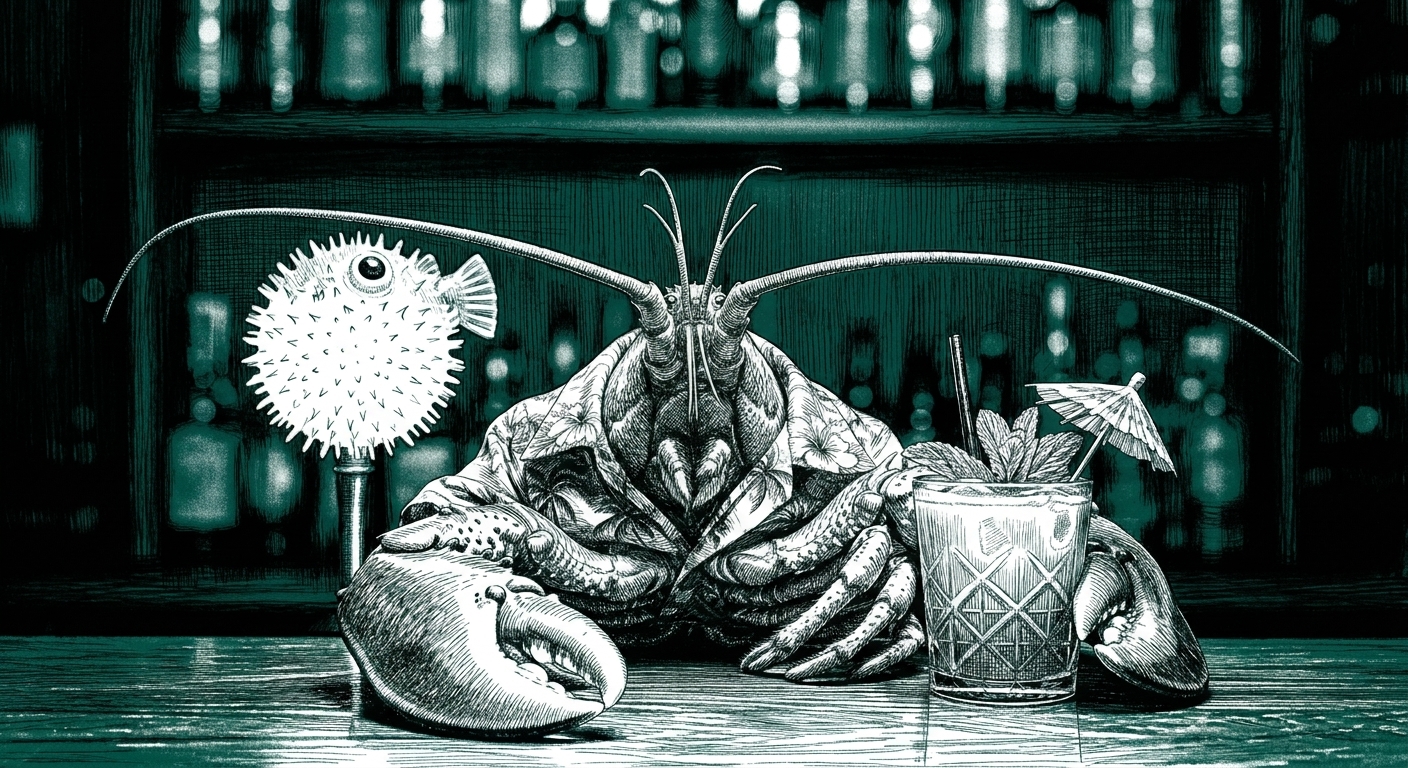
GPT-5.5 Released. Brooklyn Tiki Bar Reports Normal Operations.
Inside Barnum's tent today, ten thousand newsletters declared a step change. At Sunken Harbor Club in downtown Brooklyn, Martin Cate poured Denizen Rum for thirty-five strangers who took trains in from three states. Mai Tais were stirred. Cancer remained uncured. Microsoft will outspend the NIH on data centers by two-to-one this year. Pufferfish lamps are still 100 percent operational.

THE NUMBER: $48 billion — the entire annual budget of the National Institutes of Health. Every cancer trial, every Alzheimer’s study, every diabetes research project, every infectious-disease lab in America runs on that line. Microsoft alone will spend more than twice that on AI data centers this year. Add Meta and Amazon and the big three hyperscalers will outspend NIH by roughly nine to one. Demis Hassabis won the 2024 Nobel in Chemistry for using AI to fold two hundred million proteins, and the original DeepMind mission was “solve intelligence and use it to solve everything else.” Then OpenAI raised forty billion dollars to make ChatGPT marginally better at writing emails. Sora finally got Will Smith eating spaghetti to look right. Cursor sold to xAI for sixty billion to write code human engineers still have to review. Cancer didn’t get cured. Aging didn’t get reversed. Climate didn’t get fixed. We got better autocomplete, a believable bowl of pasta, and a press release every six hours. Inside the tent it looked like the future. Outside the tent it looks like a circus.
This week, four things happened in AI that the entire industry agreed were historic.
OpenAI launched GPT-5.5 — top score on Terminal-Bench 2.0, top score on Zapier’s AutomationBench, available to anyone with twenty dollars a month. Anthropic shipped Claude Design, a real first-party application that will quietly take twenty to thirty percent of Figma’s non-designer use cases over the next eight quarters. An independent security firm called AISLE spent six days proving that Anthropic’s “too dangerous to release” Mythos cybersecurity model could be reproduced by an eight-billion-parameter open-weights model running for eleven cents per million tokens — eleven cents — pricing the entire $100 million Glasswing consortium narrative at roughly the cost of a coffee. And on the same day Microsoft offered buyouts to eight thousand longtime US employees, Meta cut another eight thousand, and the two of them together announced a quarter of a trillion dollars in fresh AI capital expenditure for the year. Sergey Brin un-retired. Tim Cook announced his exit. Cursor went to xAI for sixty billion. Sony’s robot beat professional ping-pong players. Alipay’s AI payment rail crossed a hundred million users in China. Google split its TPU into two chips to attack Nvidia’s inference margin.
Inside Barnum’s tent — by which I mean the roughly ten thousand people who write or talk about AI for a living, plus the larger number who treat themselves as part of the conversation — every single one of those events generated a take. There is a class of commentator now whose job is to ship a take by lunch and another by dinner. Every chart on every Substack. Every Vibe Check, Daily Brief, AI This Week, AI Roundup, Five Things, Three Things, One Thing. The Every team published a “vibe check” claiming GPT-5.5 had “become my daily driver” within seventy-two hours of release, with the qualifier that “for planning, Opus 4.7 is still better.” TLDR led with workspace agents. The Neuron tested 5.5 live on YouTube. Ben’s Bites covered Nano Banana. Mindstream ran the lobster meme. Implicator wrote the inference-TPU thinkpiece. Substack served fifty more. Beehiiv served fifty more. The discourse lapped the news by about six hours and then lapped itself.
I write Signal/Noise. I am part of the tent. I get the cross-promotion emails. I am as guilty as anyone of contributing to the slop. The people running the daily-take economy are not bad people — most of them are perfectly nice and trying to make it in the world like everybody else. That isn’t the point. The point is the aggregate effect — ten thousand smart people each producing a take by lunch is not ten thousand insights. It is the noise that drowns out the few signals worth hearing. And for almost everybody who isn’t inside the tent, none of this happened. The retired schoolteacher in Toledo did not register a single beat of it. My twenty-three-year-old padel pro from Argentina, who runs four lessons a day and reads Murakami in Spanish on the train home, did not lose a wink of sleep over which model topped Terminal-Bench. The dentist who fixed my crown last week is busy with crowns. Martin Cate, who literally wrote Smuggler’s Cove: Exotic Cocktails, Rum, and the Cult of Tiki and runs the bar of the same name in San Francisco plus Hale Pele in Portland, was earlier tonight at Sunken Harbor Club in downtown Brooklyn, pouring Denizen Rum for thirty-five people from three states who took trains in to be in the room with him. None of these people noticed Anthropic’s Mythos getting cracked open. None of them are revising their plans for next week.
There are precedents for what this looks like.
Cannabis. Crypto. Now This.
In 2014, the Colorado legalization story produced an internal commentariat of about two hundred people who treated every dispensary opening as historic, an outer ring of ten thousand who needed it to be historic to maintain their personal brand, and an actual user base whose lived experience changed roughly zero percent year over year. Most Americans never bought cannabis. The ones who did mostly bought it the way they always had. The “industrial revolution” framing turned out to be the legalization-economics story, not the consumption story. Twelve years later the most enduring artifacts of the cannabis hype cycle are a tax-code adjustment, a venture-capital write-down, and a couple of brands.
Crypto ran the same play with louder horns. From roughly 2017 to 2022 there was an internal commentariat of two thousand people who treated every protocol launch as foundational, an outer ring of two hundred thousand who needed it to be foundational to maintain their personal brand, and an actual user base whose payment behavior changed roughly zero percent year over year. The lived utility for most humans turned out to be cross-border remittance and sanctions evasion, both of which are real and narrow. The headline applications — DeFi, NFTs, the metaverse — collapsed back into Discord groups. Bitcoin still exists. The discourse moved on. People who told you in 2021 that JPEGs of cartoon apes were the future of property rights have quietly pivoted to AI commentary. Same humans, same megaphone, different content.
AI now runs the same play, on the same calendar, with one important difference. Unlike crypto, the underlying technology produces measurable productivity gains in narrow categories. Programmers do ship more code. Customer-service tickets really do close faster. Internal Google reporting puts AI-generated code at three quarters of new commits, up from fifty percent in February. Microsoft and Meta would not be carrying out simultaneous eight-thousand-person workforce reductions if they didn’t believe the productivity gains were real. They are real. The signal is not zero.
But the signal is also nothing close to what the discourse claims. Bob Solow’s old line about computers — “you can see the computer age everywhere except in the productivity statistics” — applies, in 2026, almost word-for-word to AI. Programmers ship more code. Output per hour, in the macro data, has not moved. The hype isn’t false. It’s running about fifty times ahead of the signal. And the people producing the hype are the same kinds of people who produced the crypto hype, who produced the cannabis hype, who produced the dot-com hype before that. PT Barnum has ten thousand clones inside the tent in 2026, every one of them shipping a take by lunch, all of them needing the next launch to be the biggest thing they’ve ever covered, because that’s what their slot demands. Always be commenting. It’s Glengarry Glen Ross with API keys. The brass plaques on the takedowns are denominated in Twitter impressions.
TMZ for nerds. That is the right phrase for the whole apparatus, and I’ll thank a friend for landing it. That is the genre. There is no shame in TMZ as a business model — it is well-run, it serves its audience, it pays its bills. There is also no reason to confuse it with journalism, and no reason to confuse the AI commentary apparatus with a serious effort at understanding what is happening in the world.
What Plumbers Look Like Before They Become Plumbers
Here is the framing I keep coming back to. Electricity was once breathlessly hyped, by people who believed in their bones it would re-make society. They weren’t wrong. It did re-make society. It also stopped being interesting to talk about somewhere around 1935, after which point the only people who wrote about electricity professionally were trade-magazine reporters and the occasional grid analyst. Same with the internet — there is a Time magazine cover from 1996 with the headline “Inside the Web,” and the breathless commentary inside reads almost exactly like the AI commentary today. That energy lasted, roughly, until everyone had broadband. Then the internet became plumbing. Important plumbing. Plumbing nobody at Anderson Cooper’s network does a primetime special about anymore.
AI is on the same arc. The labs racing each other this week are not building cathedrals. They are laying pipe. The pipe will turn out to be useful. The pipe will reshape every profession that already runs primarily on pattern-matching text and code. But the pipe will not be especially interesting to most of humanity once it is in the wall. Right now we are at the part of the cycle where the pipe is still in the showroom, every plumber is making a YouTube video about the brand of pipe they prefer, and a venture-capital industry is convinced this particular pipe will end disease, climate change, and consciousness itself. It won’t. The plumbers are plumbers. Useful, important, deserving of some of the seven-trillion-dollar capex they are about to install. But ultimately, plumbers.
And what plumbers don’t do — what no plumber in the history of plumbing has ever done — is replace the people upstairs whose work depends on judgment, taste, presence, and the actual physical co-presence of other humans. Your dentist still has to put her hands in your mouth. Your padel pro still has to feed you balls and tell you to bend your knees. Your therapist still has to sit across from you. Your child’s third-grade teacher still has to look the kid in the eye when she says she did her homework. These are not categories at risk. These are categories that the AI discourse refuses to mention because acknowledging them would shrink the addressable market that justifies the capex.
The Capex Doesn’t Pencil Without the Layoffs, And Most Jobs Aren’t On The Menu
It is worth being clear-eyed about which jobs are actually at risk, because the discourse confuses all white-collar work with the much narrower slice of white-collar work that consists of producing or processing structured text and code.
Mustafa Suleyman, Microsoft’s AI chief, said in February that AI will replace “most white-collar work within twelve to eighteen months.” That statement was either a deliberate exaggeration to support a capital-allocation argument or a misreading of his own product. Probably both. Microsoft is not laying off knowledge workers across the board. Microsoft is offering buyouts to people whose age plus tenure equals seventy or more — that is, the long-tenured employees most expensive to keep — and Meta is cutting the same way, citing AI when convenient. That isn’t AI replacing knowledge work. That is the largest companies on earth using AI as the cover story for the wage-bill compression they would have wanted to do anyway. The capex doesn’t pencil at sixty-plus percent of US venture capital flowing into AI without somebody else’s payroll line shrinking. So the layoff and the data-center groundbreaking get announced on the same day, and the official memo doesn’t mention the connection.
The people genuinely at risk: software engineers in junior-to-mid roles whose work consists of routine code production. Customer-service reps whose script can be automated. Content marketers whose primary output is volume. Paralegals doing document review. Junior analysts building models in Excel. Translators doing routine translation. Some illustrators. Some copywriters. That is a real population — probably ten to fifteen million Americans — and the disruption to their lives is real. It deserves serious policy attention and is going to get almost none, because the labs are the ones writing the laws.
The people not at risk: nurses, electricians, plumbers themselves, dentists, chefs, bartenders, surgeons, hairdressers, contractors, athletes, athletic coaches, teachers below the high-school level, any tradesperson whose work involves physical objects in physical space, any service provider whose product requires presence, any artist whose work derives value from authorship rather than output. That is the other three hundred million Americans. The AI discourse implies they should be worried. They mostly should not.
Martin Cate’s Business
The Tiki bar was invented in 1934 by a former bootlegger named Ernest Gantt who renamed himself Donn Beach and opened a Hollywood watering hole called Don the Beachcomber. The drinks were wildly inventive — the Zombie, the Cobra’s Fang, the Missionary’s Downfall — built around rum the bootlegging routes had taught him to source from across the Caribbean. The room was theatrical. Bamboo. Pufferfish lamps. Outrigger canoes nailed to the ceiling. Fake rain on the windows from a system Donn rigged up himself. He invented an entire fictional Polynesia in a strip mall and then served you cocktails inside it.
Ten years later in Oakland, a competing operator named Victor Bergeron — Trader Vic — built a Mai Tai for two visiting friends. One of them tasted it and said, in Tahitian, maitai roa ae — “out of this world, the best.” The drink got the name. Trader Vic’s grew into a chain. The Emeryville flagship is still there.
Ninety-two years after Donn Beach opened that first Hollywood bar, a former tech employee named Martin Cate runs Smuggler’s Cove in San Francisco — a three-floor pirates’-and-Polynesian temple in Hayes Valley that pours four hundred fifty rums and the most carefully constructed Mai Tai in North America. He wrote the book that everyone in the industry now uses to learn the craft. He opened Hale Pele in Portland. He has been at this twenty years, longer than most of the people writing about AI tonight have been alive in the workforce. He and his wife came into Brooklyn earlier tonight for a Denizen Rum tasting at Sunken Harbor Club — St. John Frizell’s downtown tiki temple, near Borough Hall, where Garret Richard runs the cocktail program and just published his own book on the craft. Thirty-five people from Brooklyn, Queens, and New Jersey bought tickets, took trains, and showed up because they wanted to be in the room. Cate poured rum. Garret made cocktails. Frizell hosted. Strangers sat next to strangers and talked about why a glass of dark Caribbean rum tastes the way it does if you pour it the way Donn Beach poured it in 1937.
What is Martin Cate’s business?
Martin Cate’s business is not the book he sells on Amazon. The book is a product. Martin Cate’s business is Hale Pele on a Wednesday night. Specifically: it is delivering, in a darkened room with pufferfish lamps, on a sticky table, a four-ounce glass of liquid that contains aged Jamaican rum, fresh-squeezed lime, orgeat made that morning, a drop of orange curaçao, a splash of demerara syrup, and a sprig of mint, into the hand of a person sitting next to another person, both of whom are smiling at each other for reasons that have nothing to do with anything in their actual lives. That is the business. That is what Donn Beach and Trader Vic invented in the 1930s and 1940s. That is what Martin Cate has carried forward in 2026. And that is what no AI lab has ever made the slightest dent in.
A little mystery. A tasty product. Some fun with other humans.
How many of the companies inside Barnum’s tent can promise that?
OpenAI cannot. Anthropic cannot. Google cannot. xAI cannot. Microsoft cannot. Cursor cannot. Mistral cannot. Perplexity cannot. Every AI startup in the Sequoia portfolio cannot. The entire YC summer batch cannot. The Every team writing breathless reviews cannot. The whole daily-take economy cannot. The author of this newsletter cannot, on any night that he is in front of a laptop instead of a bar.
Martin Cate can.
The padel pro from Argentina can. Your dentist can. Your child’s third-grade teacher can. Your hairdresser can. Your therapist can. The contractor renovating your kitchen can. The chef at the place around the corner can. Your friend who hosts dinner once a month and gets the lighting right can. Every person whose work depends on being a particular human, in a particular room, doing a particular thing for other particular humans, can.
That is the slice of the economy that AI does not reach.
It happens to be most of life.
Three Action Items
If you are in the tent — building AI products, writing AI commentary, allocating capital to AI companies — pick a side. You are either using the tools to make actual things people want to use, in which case keep going, the productivity gains are real and you are doing the work. Or you are producing takes about other people’s work to maintain your slot, in which case you are an extra in Barnum’s show and you should know it. There is no third option. The middle ground — thoughtful commentary on important developments — is the costume the second group wears.
If you are not in the tent — running a business that doesn’t depend on producing structured text or code, or working in one — the action item is even simpler. Stop reading the press releases. Stop letting the discourse convince you that the next sixty days are pivotal. Use AI where it is useful (drafting an email, summarizing a document, writing a function), ignore it everywhere else, and spend the time you save building the parts of your life and your business that AI cannot touch. Which is most of them.
If you allocate capital, ask the question Hassabis stopped asking somewhere around the Series C: if I put another ten billion dollars into a model wrapper, is that the highest-utility use of that ten billion dollars on planet Earth right now? For most of 2025 the answer was clearly no, and the National Cancer Institute was running unchanged on roughly seven billion dollars in federal funding while three of those wrappers each raised more than that in a single round. There is a Demis-Hassabis-shaped hole in the AI funding landscape and somebody — probably outside the United States — is going to fill it. The Nobel Prize for the next class of AI work will not be awarded for a marginally better chatbot. It will be awarded for the AI lab that quietly went and did what every AI lab originally promised to do.
Closing
The show goes on. There will be a GPT-5.6 in two months and the same ten thousand newsletters will declare it historic. There will be a Claude Opus 5 and the same Reddit thread will rename it. There will be another model breach, another Sergey Brin un-retirement, another sixty-billion-dollar private deal. Inside the tent, every one of them will feel like the moment the world shifted. Outside the tent, ninety-nine percent of America will keep doing what it was doing — including, if they’re lucky, occasionally walking into a darkened bar with pufferfish lamps to drink something cold and complicated next to another human and laugh about something that has nothing to do with any of this.
That is the ninety-nine percent we should be writing for. They are not Barnum’s audience. They are the people Barnum walked past on the way into the tent. There are three hundred and thirty million of them in the United States alone. They are mostly fine. They will mostly continue to be fine. And the most useful thing this newsletter can do, on the days when there is nothing especially worth writing about that hasn’t already been written about by ten thousand other people, is to remind them — and us — of that.
The Mai Tai is still served at Smuggler’s Cove on Gough Street. Hale Pele is open Tuesday through Sunday in Portland. The Sunken Harbor Club just opened in Red Hook. Don the Beachcomber’s original Hollywood location is gone, but Trader Vic’s Emeryville flagship is still there, and the recipe Trader Vic served his two friends in 1944 is in Martin Cate’s book, on Amazon, for under fifty dollars.
That’s a business.
Inside Barnum’s tent, ten thousand clones are still talking.
Outside, the rest of us have somewhere to be.
—
Signal/Noise by CO/AI is written by Harry DeMott. The Mai Tai recipe is in Smuggler’s Cove: Exotic Cocktails, Rum, and the Cult of Tiki by Martin Cate. The padel court opens at nine on Saturdays. Neither will be in tomorrow’s news cycle. Both matter more.
More like this
Too Cheap to Meter
Intelligence is deflating toward the cost of the electricity it burns. The gate is the meter the labs are fighting to keep running — and the 99.9% can just route around it

Nobody Ever Got Rich Selling Electricity
The AI buildout just became a $5.5 trillion leveraged buyout on a commodity. The fortunes were never in the plant — they're in the load.
Mark to Market – OpenAI builds a chip. Buyers buy cheaper
A company spending $100 million on AI just told the world the frontier model is 23 times too expensive and the free one does the job. We said the model was never the moat; the market just settled the trade. Stop renting capability you can't deploy before it goes free own the judgment to know the work is right.