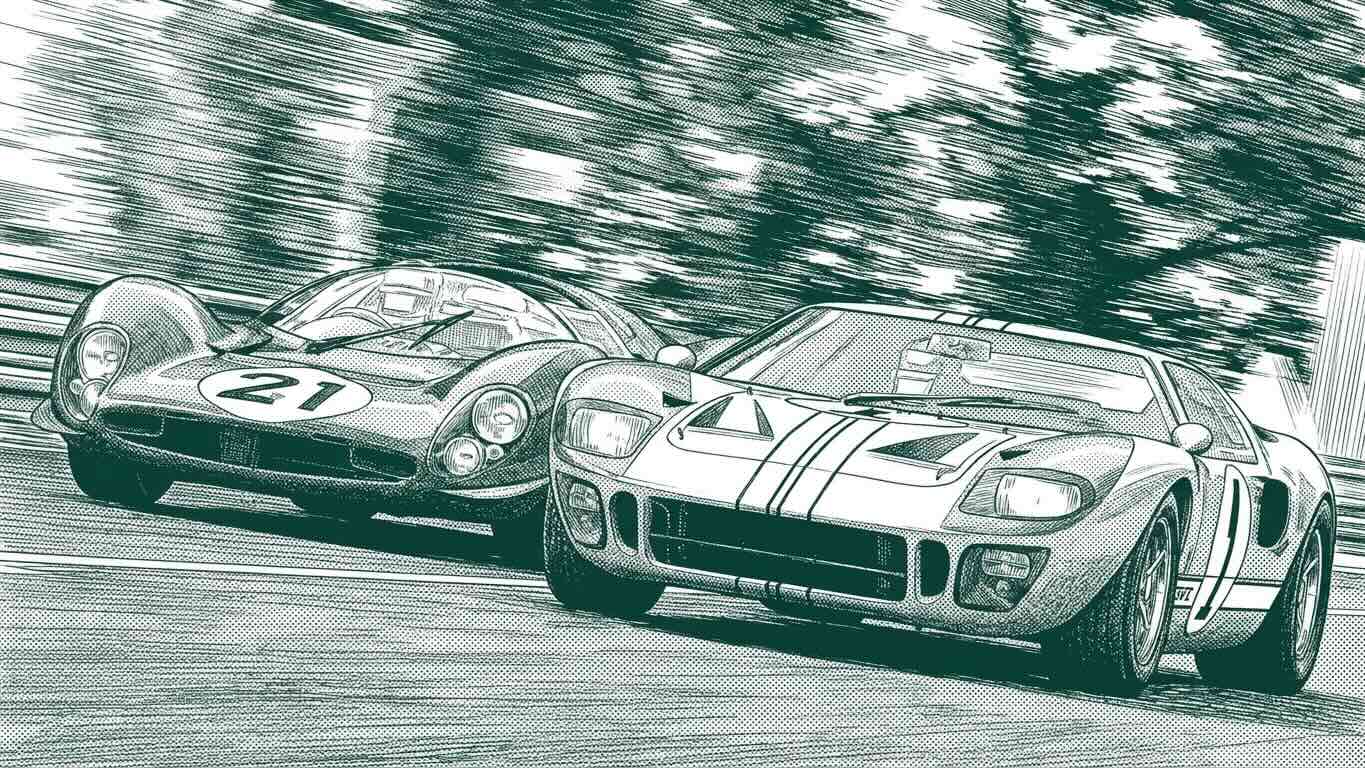
Ford v Ferrari
Eighty-six cents of every venture dollar this year bought the fastest car on the grid. Ferrari won Silverstone on Sunday and it's still a $68 billion company. Nobody wins Le Mans with the qualifying lap.

THE NUMBER: 86% — the share of every US venture dollar in the first half of 2026 that went into AI. PitchBook closed the books this week: $412.7 billion deployed, $355.9 billion of it into AI companies. That is not a sector allocation. That is the whole market putting nearly nine of every ten chips on one number at the table. And here is the thing about a bet that size — it only pays if the thing you bought is worth what you paid. Most of that money chased the frontier, the fastest, most capable models money can rent. This issue is about whether the fastest car is the one that actually wins the race capital is running. Hold the number. Everything hangs off it.
🏎️ I Took the Ferrari Off the Grocery Run
I switched my newsletter pipeline off Fable 5 this week. Not because I hit a wall — I wasn’t close to a limit. I switched because Fable 5, the most capable model money can rent right now, is an overfit for what I actually do, the way a Ferrari is an overfit for a run to the store for milk and eggs. Opus 4.8 finishes the same job for a fraction of the freight, and I stopped setting the difference on fire every morning.
Sit with that, because I’m exhibit A and I know it. I publish about this industry at dawn every single day. My entire product is high-end reasoning and writing — the exact work the frontier tier is supposed to be built for. I am the single best-fit customer that top model will ever find. And I looked at the bill, looked at the output, and stepped down a tier without losing a thing. If the guy whose whole job is to need the Ferrari won’t pay to keep it in the driveway, you should be asking a very uncomfortable question about who, exactly, the premium tier is priced for.
Every asks it in public every week — they run a “Vibe Check” where they route jobs across Sol, Fable, and Opus by task, and they’ve said the quiet part out loud: the top model gets the biggest, loosest assignments, and the cheaper one is the model they want open all day. That’s not a knock on the frontier. It’s a routing table. And a routing table is the sound a premium losing its pricing power makes.
🐎 A Great Business and a Terrible Stock
Here’s the trap the $355.9 billion walked into. It funded the frontier labs on the Ferrari story — hand-built, scarce, the fastest thing on the grid — and then priced them like Toyota.
Look at the real Ferrari. Not the metaphor, the company, RACE on the exchange. It is the most profitable carmaker alive, margins that make Stuttgart and Detroit weep, a brand two generations of grown men have taped to their bedroom walls. It is worth about $68 billion. That’s it. Toyota is worth several times that on a fraction of the margin, because Toyota builds ten million cars a year and Ferrari builds thirteen thousand on purpose. Ferrari’s small market cap isn’t a failure of the business. It is the business. Scarcity is the strategy, and the ceiling is the cost of the strategy.
Now put Anthropic’s rumored $1.2 trillion mark next to a $68 billion Ferrari. That’s seventeen Ferraris. One AI lab, priced at seventeen of the most desirable scarcity businesses on earth — sold on the Ferrari story of hand-crafted, best-in-the-world intelligence, and valued on Toyota’s volume, as if it will both stay exquisite and sell to everyone. You cannot be both. Ferrari knows you cannot be both. The market just wrote a check that says you can.
And the frontier can’t choose Toyota even if it wants to, because the moment it reaches for volume, a Ford pulls up alongside.
⛽ Jevons Bought the Wrong Car
The whole $355.9 billion is underwritten on one idea, even if nobody names it: Jevons paradox. William Stanley Jevons, 1865, watching coal — make the steam engine more efficient and England didn’t burn less coal, it burned vastly more, because cheaper power meant everyone found a new use for it. Ported to AI: tokens get cheaper, usage explodes, total spend outruns the price cut. That’s the bull case for paying up. More efficient, more used, more revenue. Fine.
Jevons is real. But Jevons never tells you who captures the exploding usage, and that’s the entire game. Benchmark’s Peter Fenton put a clock on the answer this week: 90% of tokens will run on open-weight models inside eighteen months. Tomasz Tunguz, the same week, published the data underneath it — Ollama past 8.9 million developers, adding nearly a million a week, on 85% of the Fortune 500, most of it running DeepSeek and GLM and Qwen locally and only bursting to the cloud for the hard 20%. A trillion-parameter model now runs on a local box for $94,000, a cost curve collapsing faster than anything in the history of computing.
Read those two facts together and the paradox turns cruel. Usage is about to explode — and the explosion lands on open models that didn’t take a nickel of the $355.9 billion. The people who funded the frontier priced in the Jevons boom and then watched it route around them. They were right about the paradox and wrong about which side of it they were standing on. They paid for the whole demand curve and got to keep the top ten percent of it.
We have watched this exact movie before, and recently enough that the tape is still warm. The late-nineties telecom build — WorldCom, Global Crossing, the fiber barons — raised and spent a fortune laying glass on the theory that internet traffic would explode. Traffic did explode. The companies that laid the fiber went bankrupt anyway, and the value accrued to whoever lit the dark fiber cheap a decade later. The demand forecast was correct. The capital still got vaporized, because being right about the boom and being the one who profits from it are two different bets. Eighty-six cents of every venture dollar just made the first bet and called it the second.
🔀 Four Cars, Four Engines
Here’s what the “race to the bottom” framing misses. The frontier is bifurcating, and the four models that launched in a single afternoon this week aren’t four contestants for one crown. They’re four different cars.
Fable 5’s real strength at the top end isn’t code — it’s reasoning, creative work, the big loose assignment you hand off completely. The latest OpenAI models hammer out work and are strong coders. Grok is genuinely unhinged in the best way and excels at code. So when Grok 4.5 shows up this week doing a coding task for $1.51 that Fable Max bills at $17.32 (one-eleventh the cost, on CursorBench, at eighty tokens a second), it doesn’t hit all three the same. It aims straight at the lab that monetizes coding and sails right past the one whose money is in reasoning. That’s bad for OpenAI, whose bread-and-butter high-value token is exactly the kind Grok just underpriced. It’s a flesh wound for Anthropic, which barely competes there and had its coding-tuned Fable gated by Commerce anyway, forced to an Opus 4.8 fallback. The attack landed on the one target it was shaped to hit.
Now, the honest objection, because a sharp reader will raise it: cars don’t scale, software does. A model has near-zero marginal cost to serve, so why can’t the frontier be Toyota, infinite units at a fat margin? Because the premium is only defensible at low volume. The second you push a frontier model into the mass market, a Ford — Grok at a tenth the price, an open weight for free — takes the volume, and you’re left holding margin on the thin slice that genuinely needs the thoroughbred. It’s Ferrari not because it’s hand-built, but because the defensible premium only exists on a small racetrack. Scale it and you don’t become Toyota. You become Ford, at Ford margins, having spent Ferrari money to get there. The scarcity was never in the manufacturing. It’s in the size of the track.
And there is only one durable way to hold a lane: own a moat that doesn’t reset every six weeks. Grok’s coding edge, by itself, is a six-to-eight-week lead — GPT-5.6 just landed doing the same job, and it’ll fast-follow. What makes Grok’s position stick isn’t the benchmark. It’s that Grok was co-trained on Cursor’s proprietary coding data and now lives inside Cursor, which SpaceXAI is buying for $60 billion. The switching cost and the data flywheel are the moat. Rest the thesis on model quality and it expires on schedule. Rest it on the flywheel and it survives the next drop. Which brings us to who actually owns the flywheels.
🏠 SpaceX Is the House
Watch where Elon Musk points his fire, because it tells you the board has quietly realigned. He sued Sam Altman. He built Grok to eat the exact coding turf OpenAI monetizes. And this week he went on X and effusively praised Anthropic, called it the clear leader, admitted he’d been wrong — the same week SpaceXAI started selling Anthropic its idle GPU compute. He knifes OpenAI and feeds Anthropic. Two of the families reached an understanding; the third is getting isolated at the table.
Don’t mistake it for friendship. It’s the cleanest business position in the industry. SpaceX rents Anthropic the compute for the reasoning tail Grok doesn’t contest — so Anthropic’s growth pays SpaceX. Its own Grok takes coding share straight out of OpenAI — so the head-to-head fight pays SpaceX. And it owns Cursor, the surface where a huge slice of that coding inference gets routed, so the distribution pays SpaceX too. Long the reasoning tail, long the coding war, long the pipe. Heads it wins, tails it wins, and it does not care which model is best because it takes a cut of every hand. Two weeks ago we told you to own the table, not the players. SpaceX went and bought the table.
There’s the dark rhyme, and it’s why the funding story and the fragility story are one story. The house is public. SpaceX went out at a $1.7 trillion IPO, the largest in history, raised $75 billion, cleared $2 trillion in early trading, and it swallowed xAI for $250 billion and is buying Cursor for $60 billion. So the single entity structurally guaranteed to win is also the one marked to market every day, and because the whole trade now references it — Nvidia funding its own customers, the memory makers, the Mag7 capex, the private labs — there is no wall left between the house and the floor. The winner and the correlation risk are the same ticker. One domino goes and they all go, because it stopped being a row of dominoes and became one block wearing eight names. The KOSPI shed ten percent on an unconfirmable rumor a couple of weeks back. That was the fire drill.
⚖️ Schrödinger’s Valuation
So why does the 86% look fine, if the thesis says it overpaid? Because almost none of it has faced a jury.
SpaceX stood in front of the market, took its verdict, and the number held. Anthropic at a rumored $1.2 trillion and OpenAI at whatever-it-is are still in the green room — private marks that can keep climbing precisely because nobody can prove them wrong until a public window opens and a real price collapses the guess. That’s Schrödinger’s valuation: the mark is both real and imaginary until the IPO opens the box. And the tell is sitting in plain sight. OpenAI is, in every honest account, a mystery on whether or when it clears the public window. When or if. A company that could pass the jury sets a court date. A company that isn’t sure keeps postponing. Anthropic bolts a Nobel economist onto its oversight board and raises at ever-richer private marks; the marks stay aloft in exactly the medium where they can’t be falsified.
None of this means the frontier labs are bad companies. It means the marks are un-adjudicated, and a $355.9 billion bet resting on un-adjudicated marks is a very different risk than the confident consensus makes it sound. Galloway’s been saying a fifty-to-seventy-percent drawdown is coming, and he’s probably right, and it has almost nothing to do with whether AI is real. The technology is real. The price is a guess wearing a suit.
🏆 The Fastest Car Never Wins Le Mans
Ford tried to buy Ferrari in 1963. Got to the final page, and Enzo tore the deal up and insulted Henry Ford II to his face. So Ford did the American thing: went home, spent a fortune, and built a car for the one place Ferrari’s whole legend lived — Le Mans, the 24-hour endurance race Ferrari had owned for years. In the film, Enzo sneers that Ford builds “ugly little cars in ugly factories.” Ford’s ugly car, the GT40, finished 1-2-3 at Le Mans in 1966 and won the next three years running. Not because it was more beautiful. Because it was engineered to still be turning clean laps at hour 23 while the thoroughbreds sat in the pit with the hood up — reliability, fuel strategy, Ken Miles reading his brake temps, Carroll Shelby doing the math.
That’s the whole issue in one race. This week’s launch calendar is Silverstone — 52 laps, one bright afternoon, and the fastest car wins. Charles Leclerc proved it Sunday, taking the British Grand Prix for Ferrari because when the track demands a thoroughbred you bring a thoroughbred. Nobody wins Silverstone in a Corolla. But capital does not run sprints. Capital runs Le Mans, the five-to-ten-year hold, and no one has ever won the 24 Hours with the qualifying lap.
So if you’re allocating, stop buying the fastest car and start buying the one built to finish. The AI names that return capital over a decade aren’t the pure Ferraris — they’re the Porsches, the ones with a halo bolted onto a Cayenne that actually pays the bills, or the full-line manufacturer that already owns the dealership. That’s why the boring answer keeps being Google: the halo of DeepMind sitting on top of Search, Android, Cloud, and Workspace — the largest distribution fleet ever built, the car that’s still running at hour 23 while everyone films the qualifying lap. It’s why OpenAI is sprinting into a consumer app and ads, trying to build a Cayenne under the halo before the premium token gets commoditized out from under it. And it’s why a pure frontier bet with nothing scaled beneath it is a $68 billion business wearing a trillion-dollar tag.
The convergence is already showing up in the smart money’s own words. Palantir’s Karp says the labs “oversold” and that enterprises want to “own the means of production.” Mozilla is building an open control plane and calling control the new moat. Fenton’s ninety percent. Tunguz’s eighty. They’re all describing the same thing from different windows: the value left the model. It’s a component now, cheap and ownerless, and the only durable premium sits on the couple of data-moated islands where a flywheel holds the water back. Everywhere else, the sea is free, and cheap tokens are good enough for the sea. You only pay for the Ferrari to reach an island — and there are far fewer islands than there was capital.
Eighty-six cents of every dollar bought the fastest car on the grid. The fastest car never wins Le Mans.
Buy the one built to finish.
— Harry and Anthony
Sources
- US venture funding hits $412.7B in first half as AI deals dominate — $355.9B (86%) into AI; rounds ≥$100M were 87.5% of dollars; sub-$100M share of value fell 43.8% (2024) → 12.5% (2026); Anthropic $65B round at ~$965B post; SpaceX $1.7T IPO — SiliconANGLE (PitchBook-NVCA Q2 Venture Monitor), Jul 9, 2026
- Ferrari NV market capitalization (~$68B) — GuruFocus
- 2026 British Grand Prix — Leclerc wins for Ferrari, under safety car; Russell and Hamilton on the podium — Formula 1 · Silverstone · ESPN
- SpaceXAI introduces Grok 4.5 — x.ai, Jul 8, 2026 · TechCrunch, Jul 8, 2026
- SpaceXAI, Meta put pricing squeeze on Anthropic, OpenAI — four-tier pricing $2/$6 (Grok) · $1.25/$4.25 (Muse Spark) · $5/$25 (Opus 4.8) · $5/$30 (GPT-5.5) · $10/$50 (Fable 5) — Constellation Research / Larry Dignan, Jul 9, 2026
- Grok 4.5 vs Fable 5 Max cost-per-task on CursorBench ($1.51 vs $17.32); co-trained with Cursor; ~80 tok/s — reported on X, Jul 8, 2026
- GPT-5.6 Sol public rollout (cleared federal pre-release review) — via TLDR AI, Jul 9, 2026
- Peter Fenton (Benchmark): 90% of tokens on open-weight models within 18 months — reported on X, Jul 9, 2026
- 8.9 Million AI Users — Ollama past 8.9M developers, +~1M/week, 85% of the Fortune 500; local trillion-parameter models at ~$94K — Tomasz Tunguz, Jul 9, 2026
- Elon Musk on Anthropic (calls it the clear leader) + SpaceXAI idle-GPU sale to Anthropic; Musk v. Altman litigation — reported on X / Aligned News, Jul 9, 2026
- Anthropic appoints Ben Bernanke to its oversight trust — Aligned News feed, Jul 9, 2026
- China Tells its Coders to Drop Claude — vuln-DB backdoor flag; Alibaba internal ban (effective Jul 10); Anthropic’s 25,000-account / 28.8M-exchange distillation claim; “you cannot own the intelligence layer” — Shelly Palmer, Jul 9, 2026
- Every, “Vibe Check: GPT-5.6 Sol” — routing jobs across Sol / Fable / Opus by task; Sol 56/100 vs Fable 90/100 on their senior-engineer benchmark — Every, Jul 9, 2026
- Palantir’s Alex Karp: labs “oversold,” enterprises want to “own the means of production” — AI Secret (“Enterprises Are Livid”), Jul 3, 2026
- The Control Layer / “control is the new moat”; a $200/mo test feature can cost $20,000/mo in production — Mozilla.ai, Jul 9, 2026
- The sobering of AI ($500 agent-loop bill; “cap your auto-top-ups”) — Semafor Technology, Jul 8, 2026
- Coffee’s for Closers — CO/AI, Jun 17, 2026
- Ford v Ferrari, dir. James Mangold, 2019 (the 1963 failed Ford–Ferrari deal; Enzo’s “ugly little cars”; the GT40’s 1-2-3 at Le Mans, 1966) · William Stanley Jevons, The Coal Question, 1865 (the rebound paradox) — cultural and historical anchors, not this week’s news
- Author’s own CO/AI production pipeline (switched Fable 5 → Opus 4.8 with no loss of quality; not near a usage limit) — first-person source, Jul 9, 2026
More like this
Ghost in the Machine
Anthropic just found that ghost inside Claude. Last night, Claude Fable 5 refused a job I never asked it to judge. The machine you can finally read is the one you still can't predict so stop asking it to be consistent and hard-wire the steps that can't afford an opinion.

The Wolf
The AI labs just spent $10 billion hiring ten thousand of him, because the one thing they can't rent is a way into your building.
The Doors of Perception
Huxley called the mind a reducing valve the lens all work squeezes through. Anthropic just found Claude's, and measured it: 25 concepts wide to our four, and readable for the first time.