
AI Beats and Backlogs: A Tale of Four Companies


THE NUMBER: $460 billion — Google Cloud’s signed backlog at the end of Q1 2026, after it nearly doubled in a single quarter. That’s more than two times Google Cloud’s trailing-twelve-month revenue. It’s the line in tonight’s earnings that turned all four hyperscaler reports from a beat into a verdict. The bears spent three years arguing about whether AI demand was real. Tonight, $460 billion in signed contracts answered the question. Now Wall Street is asking the next one — whose AI capex is showing up as AI revenue, and whose is still a roadmap. Google answered it. Meta didn’t. Microsoft is somewhere in between. Same beat. Three different verdicts.
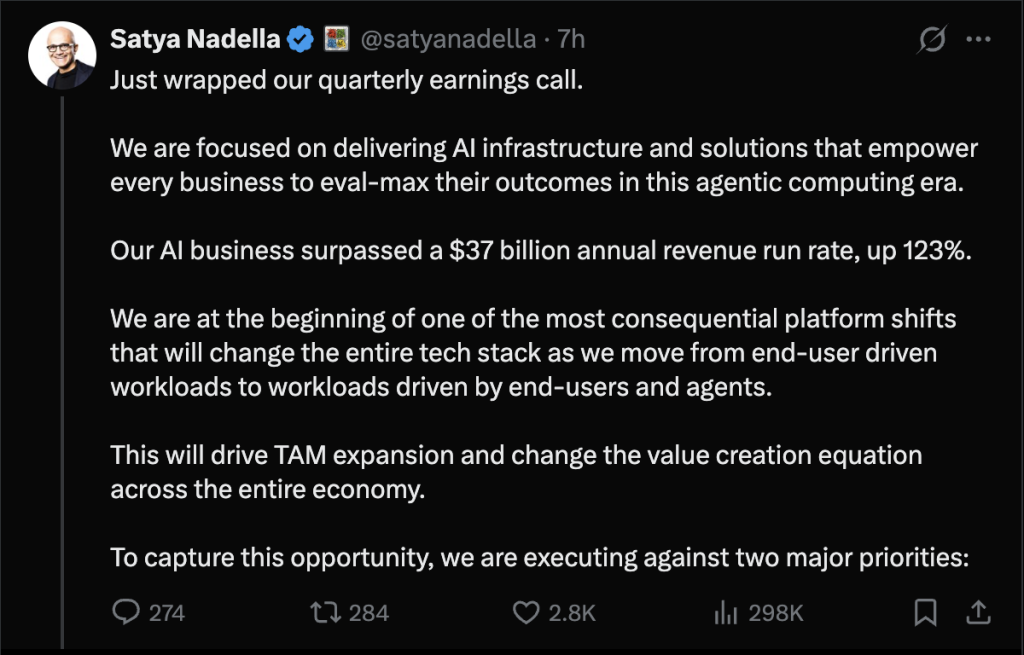
For the first time since October 2020, all four hyperscalers reported earnings the same night. Alphabet, Microsoft, Meta, Amazon. Every one of them beat. Every one of them credited AI. Combined revenue: $430.6 billion in a single quarter. Combined Q1 capex: $112 billion — on pace to crack $600 billion for the year. Google Cloud grew 63% to $20 billion, the fastest in its history. AWS grew 28%, its fastest pace in fifteen quarters. Azure grew 40%. Microsoft’s AI business hit a $37 billion annual run rate, up 123% year over year. Meta revenue grew 33% — the fastest top-line print in the Big 4. Net income grew 61%. The bubble argument died at 4:01 PM ET.
And yet, by 5:30, Alphabet was up 7% after-hours, while Microsoft and Meta were both red — Meta down nearly 7% on a beat-and-raise. Same night. Same earnings calendar. Same AI thesis. Three opposite reactions. That’s the story.
The cleanest way to read the split is that Wall Street just changed the metric. For two years the question was whether the hyperscalers would commit enough capex to win the AI cycle. They did — $112 billion in one quarter, with Alphabet selling a 100-year century bond (the first by a tech company since Motorola in 1997) to help fund it. Microsoft is funding from operating cash flow. Amazon and Google are levering up. Bank of America forecasts $175 billion in hyperscaler debt issuance in 2026 — six times the prior five-year average. The capex commitment is now done. The market priced it. The new question is what’s the contracted demand backing it, and the answer separates the four companies into completely different stories.
Google has the receipts. $460 billion in signed Cloud backlog, doubling quarter over quarter. 330 customers each processing more than a trillion tokens. 35 of them past ten trillion. Customers outpacing their initial AI commitments by 45% and accelerating. Gen AI product revenue up 800% year over year. Gemini Enterprise paid MAUs up 40% in one quarter. Pichai literally said on the call that cloud revenue would have been higher if Google could meet the demand — they’re compute constrained. That’s not adoption-stage; that’s allocation-stage. AWS has its version of the same story: a $364 billion backlog, plus another $100 billion newly signed, plus exclusive Bedrock Managed Agents from OpenAI live within twenty-four hours of Microsoft losing exclusivity. Microsoft has the run-rate version: $37 billion, +123%. It’s real. It’s just shadowed by everything else attached to that line item.
Meta has none of those. Meta has a 33% revenue print, $26.8 billion in net income, 3.5 billion daily users across at least one app, and a capex guide raised to $125-145 billion for 2026. What it doesn’t have is a backlog metric. Or a Cloud business. Or an enterprise procurement queue. Meta sells consumer impressions. Impressions don’t show up as signed three-year contracts. They show up as ad CPMs that move with the macro. Wall Street has decided, in one trading session, that capex without a backlog metric is the wrong shape of bet right now. Meta got punished for the category of its AI revenue, not the size of it.
That’s the bifurcation. The metric just changed.
📉 The Backlog Test, and Mark Zuckerberg Is Failing It
Here’s the thing nobody is going to say out loud on cable tomorrow morning: Meta had the strongest top line of the four. 33% revenue growth. Net income up 61%. Ad business firing on all cylinders. Mark Zuckerberg got on the call and said “we’re on track to deliver personal superintelligence to billions of people.” He raised the 2026 capex guide to $125-145 billion from $115-135 billion. The headline numbers were unimpeachable. The stock was down nearly 7% in the after-market within fifteen minutes of the print.
Why?
Because Wall Street decided this quarter that they’re not paying for AI capex anymore. They’re paying for AI capex with proof of contracted demand. Google walked in with $460 billion in signed backlog and bumped its 2026 capex guide to $180-190 billion. The math reads as roughly two and a half years of demand already committed against the coming year’s spend. The capex looks light against the contracted revenue. The procurement queue is forming. The bond market is pricing it in — Alphabet sold a 100-year bond and the order book was oversubscribed.
Meta walked in with $145 billion of guided 2026 spend and no equivalent line item. There is no Meta backlog disclosure. There’s no Meta enterprise contracted-AI-revenue number. There’s no Meta cloud unit reporting how many customers crossed a trillion tokens. What Meta has is consumer ads, an impressive social graph, 8,000 layoffs starting May 20, and a CFO note that the spend is going up partly because of “higher component pricing.” That last line is the tell. When the rationale for raising capex is that GPUs got expensive, you’re not winning a procurement queue. You’re paying scarcity prices to stay in the room.
The honest read on Meta isn’t that the AI investment is wrong. It’s that Meta sells the wrong shape of AI revenue for the metric the market is using right now. Consumer impressions don’t backlog. Enterprise compute does. That difference is structural. Meta could ship the best ads-personalization model on the planet next quarter and the comparison still wouldn’t get any cleaner, because there’s nothing on Meta’s income statement that looks like a 330-customer-cohort processing trillion-token workloads with 45% commitment overage. The procurement queue Pichai is rationing on the call — Meta isn’t in that queue. Meta is the queue, on the consumer side. Same scale, different shape, different valuation right now.
There’s a second problem, and it’s worse than the first one. We don’t know what the analyst whisper number was on Meta tonight — we’re guessing on the precise miss. What we do know, structurally, is the dynamic that’s quietly inflating Meta’s beat and that nobody on the call asked about. A growing share of the impressions Meta is selling on a CPM basis are now being delivered to agents instead of humans. Every ChatGPT browsing session that crawls Instagram for product reference. Every Manus agent reading Facebook Marketplace listings on behalf of a buyer. Every Sora-style scraper pulling Reels for training data. Every consumer agent doing a “find me the right couch” task that touches Meta’s surface a hundred times before recommending three options to its principal. Each of those is an impression. Each of those gets billed to an advertiser at the CPM the auction sets. None of those is going to convert into a purchase the way a human eyeball would.
The advertisers buy on CPM. They live or die on CPA — cost per acquisition. When the impression count is inflated by agents, the CPM stays the same and the effective CPA goes up — silently, on the advertiser’s dashboard, not Meta’s. The platform’s revenue is rising while the customer’s unit economics are getting worse. That’s a setup that always reprices. Click fraud was the version of this story for two decades. Agent traffic is the 2026 version. The advertiser hasn’t yet built the analytics layer to filter agent impressions out of the funnel. They will. When they do, the CPM that was clearing at $X clears at $X minus whatever percentage of the impressions turn out to be agent traffic, and the implied revenue line in 2027 looks different than the one Meta just printed.
The line worth saying out loud, the one nobody on the call is going to say: Mark Zuckerberg keeps describing this as “personal superintelligence to billions of people.” It is not curing cancer. It is a better advertising algorithm. It is doing a better job serving up Sydney Sweeney pictures and French Bulldog videos. The substrate Meta is spending $145 billion to build is, at the level of the actual workload, a higher-resolution targeting engine for impressions that are increasingly being served to bots. That’s a real business — Google did it for twenty years and printed money. The difference is that Google has a path to monetize the agent layer itself (Gemini Enterprise, indexing licenses to agents, sponsored agent answers), and Meta does not. The agents browsing Instagram aren’t going to buy a Gemini Enterprise license to do it. They’re going to keep being free riders on top of an ad auction whose pricing was designed for human attention. That’s the structural problem. The 33% revenue print does not address it.
Why this matters: Meta’s after-hours print is the cleanest signal you’ll get all year about how the AI trade is being repriced underneath you. Capex with a backlog metric is graded on a curve that rewards you. Capex without a backlog metric — funded by impression revenue that’s increasingly being delivered to agents who don’t buy anything — is graded on a curve that punishes you, and the punishment will get worse, not better, as the agent share of impressions grows. If you’re allocating, the shape of the AI revenue is now a factor. If you’re an advertiser on Meta or any other ad-funded platform, the human-eyeball share of your CPM is now a factor too, and your CFO doesn’t have a line for it yet.
🦞 Microsoft and the Christie Brinkley Problem
Microsoft’s earnings would have been a victory lap in any other month. Revenue $81.46 billion against $75.33 billion expected. Up 18% year over year. Azure +40%. Intelligent Cloud $34.31 billion. Productivity $34.48 billion. The AI business — separate from OpenAI rev share, this is the Microsoft-branded layer — at a $37 billion annual run rate, up 123% YoY. Satya Nadella tweeted about it within minutes of the close. The growth math is real and not OpenAI-dependent. Microsoft has a perfectly fine AI franchise that runs on Azure, ships through Copilot, and prints money.
Microsoft stock was down anyway. Not catastrophically. But down on a day where the equivalent fundamentals at Google produced a 7% rally.
The reason isn’t the Microsoft business. It’s the 27% of OpenAI Microsoft is still attached to. As we wrote in Whose Side yesterday, the question every enterprise procurement team is now running on Sam Altman is the Christie Brinkley test. By the fourth and the fifth and the sixth divorce, the universe is telling you something specific about who is at the center of the pattern, and the answer is not the spouses. Christie Brinkley is by all accounts a wonderful human being, and four marriages later you still wouldn’t bet your business on the fifth. The receipts on Altman’s record are now public: the board fired him, the chief scientist left to build a competitor, the CTO left to build a competitor, the head of alignment left to build a competitor, the co-founder is suing him for $134 billion in disgorgement, and the public mission has been rewritten six times in nine years. Yesterday Day 2 of the Oakland trial put two of these receipts in the same room and let nine jurors look at them.
Microsoft owns 27% of that.
The math gets worse from there. WSJ reported Friday — and Shelly Palmer extended this morning — that OpenAI missed its monthly revenue targets multiple times this year, that CFO Sarah Friar reportedly told colleagues she’s worried OpenAI can’t fund its compute commitments if growth doesn’t pick up, and that the company is on pace to burn $25 billion against a $30 billion revenue target. Compute commitments across Azure, AWS, and Oracle now total roughly $600 billion. Twenty-four hours after Microsoft dropped exclusivity on Monday, OpenAI signed AWS Bedrock with an exclusive Bedrock Managed Agents runtime. Sam Altman appeared at the SF launch event by recorded video — because he was in Oakland for the trial. The Information separately reported OpenAI projects 112 million subscribers on its $8 ChatGPT Go tier by year-end versus 9 million on the $20 Plus plan — trading revenue per user for scale, which is the move you make when the unit economics on the premium tier aren’t holding.
Marcus Schuler at Implicator wrote the cleanest line of the morning on the AWS-Bedrock pivot: “Model access becomes multi-cloud. The harness around the model — identity, permissions, memory, logs and guardrails — becomes the premium product.” That framing is the one to keep. The model is now a feature. The harness is the company. AWS just bolted exclusive harness rights onto its largest-cloud distribution moat. And Microsoft, having traded exclusivity for a permanent royalty annuity in last week’s restructuring, just watched its single biggest model partner walk into its single biggest competitor’s enterprise sales surface.
Connect the dots: Microsoft’s $37 billion AI run rate is real, and the market is discounting it because investors can’t separate Microsoft’s first-party AI business from the Altman-shaped overhang attached to it. The 27% stake in OpenAI was the most leveraged passive position in AI when we wrote about it on Monday in Speed Eats Scale. Tonight it’s the most visible drag on a $4 trillion stock. Same stake. Same math. Different read, because the Altman pattern has finally accumulated enough receipts that procurement teams started pricing it in.
Here’s what to do: If you’re an enterprise CIO with a 2026 vendor map, separate your Microsoft Copilot/Azure spend from your OpenAI/ChatGPT Enterprise spend. They are different procurement decisions with different counterparty risk. Microsoft’s first-party AI stack — Copilot, Azure AI Foundry, Microsoft 365 Copilot — is a bet on Microsoft. ChatGPT Enterprise is a bet on Sam Altman’s ability to ship $600 billion of compute commitments against a $30 billion revenue line without being the sixth founder his board fires. Those are different counterparty risks. Most procurement teams have them on the same line item right now, and that’s why their boards are about to start asking very pointed questions. If you’re long Microsoft, the call this quarter is whether the OpenAI drag is permanent or temporary. We think it’s permanent until either (a) Altman is no longer running OpenAI, (b) the unit economics improve enough to outrun the trial, or (c) Microsoft formally distances itself from the relationship beyond the IP licensing. None of those look likely in the next two quarters.
🧠 The Bears Were Wrong About Search. Now Comes the Hard Question.
Three years ago — long enough ago that every AI commentator who made the prediction has memory-holed it — the consensus call was that ChatGPT would kill Google Search. The substitution math looked clean on a slide. People type queries into Google. People will type queries into ChatGPT instead. Search dies. Alphabet revenues collapse. Apple’s $26 billion default-search check from Google looks like a stranded asset. We covered Apple’s piece of that bet in Brutalistlast week.
The actual Q1 2026 print: Search revenue $60.4 billion, up 19% year over year, with queries at an all-time high.
Aligned News published the cleanest line on this tonight: “The ‘AI replaces Google’ trade priced in human substitution. It didn’t price in agent multiplication.” That’s exactly right and it’s worth sitting with for a second. Three years ago the bears assumed each user’s queries were a fixed quantity that would migrate from Search to ChatGPT. What actually happened is that the agentic layer started running on top of Search. Every Claude session that needs a citation queries Google. Every ChatGPT browsing session goes through Google’s index. Every Cursor or Codex agent looking up an API doc gets there through Google. And every consumer agent — Manus, Operator, the upcoming Apple-Gemini whatever-it-becomes-when-it-ships — runs queries on behalf of a human at a frequency the human would never run on her own. The agent is a 100x Google user. Queries went up because the agents have higher metabolisms.
Jason Lemkin’s SaaStr write-up — which we anchored Monday’s Speed Eats Scale on — proved this dynamic at the SaaS layer. SaaStr’s Salesforce bill went from $12,000 a year to $22,000 a year while their human seat count fell 80%. The agents query Salesforce roughly a hundred times more than the humans ever did. Same dynamic, different vendor: the agents are a more demanding customer than the humans they replaced. Lemkin’s data point should be the lens through which you read tonight’s Google Search number too. Queries are at an all-time high because AI got good. Not in spite of it.
Now the hard question. Search revenue is up. Search monetization, on the other hand, is now an open question, and Google has roughly the same window to figure it out that they had to figure out mobile in 2008. When Bill Gurley and the rest of the consensus called the iPhone-versus-Google moment, the prediction was that mobile would kill desktop search advertising. Google figured it out. Mobile became the more profitable surface within five years. The current moment rhymes. Agents are a different end-customer than humans. They don’t click ads. They don’t comparison-shop in the way the auction was designed to monetize. They synthesize results into an answer and hand it to a human who already made the decision. The AdWords auction was built for a customer that no longer dominates the query volume.
The asymmetry between Google and Meta on this is the part to underline. Both platforms are seeing agent traffic balloon. Google has a path to monetize the agent layer directly. They can license the index to agents at API rates, charge for premium ranking the way they charge for ad placements today, build a sponsored-result layer that surfaces inside agent answers, and — the bigger play — make Gemini itself the agent that runs on top of Google’s index, capturing the ad revenue at the inference layer instead of the ranking layer. That’s the structural reason Sundar tripled down on Gemini Enterprise this quarter — 40% paid MAUs growth quarter over quarter, a Pentagon classified-network deal landed within the same news cycle, GM rolling Gemini to four million vehicles via OTA. Google isn’t trying to defend the ranking auction. They’re trying to be the agent that consumes their own index and monetizes the answer. That’s a different business with a different revenue curve, and it’s working better than anyone gave them credit for two quarters ago.
Meta does not have that path. Agents browsing Instagram aren’t going to subscribe to a Meta agent platform; there isn’t one to subscribe to. Meta’s ad auction is monetized by the impression — and the impression is increasingly being served to a non-paying customer. Same problem, two different houses, two different sets of keys. Google has the keys. Meta is still figuring out which door is the right one to walk through.
The signal: Stop reading Search revenue as a referendum on whether AI is killing Google. It’s not, and the data has been unambiguous for two quarters. Read Search revenue as a measure of how much of the agent economy is running through Google’s index. That number is going up. The next question — who captures the ad dollars when the queryer isn’t a human — is the one Google has eighteen months to answer publicly. They have most of the assets. They have the bond market on side. They’re spending $185-190 billion to figure it out. Bet history.
What This Means For You
Three earnings reports separately confirmed the AI cycle is real. Read together, they confirmed something harder: Wall Street is now grading AI capex on a curve, and the curve is contracted demand. The companies whose AI revenue shows up as signed multi-year backlog are getting capex green-lit at scale. The companies whose AI revenue shows up as consumer impressions or “trust us, the agents will love it” are getting punished for the same level of spend. That’s a structural shift in how AI is valued, and it happened in a single trading session.
Stop reporting “AI capex” as one number. Your board, your investors, your customers — every audience for a 2026 strategy update — wants to know what backlog is backing the spend. If you’re a public-software CEO, this is the metric to lead with on your next call. If you’re a private-company founder, this is the metric to lead with on your next pitch. The dollar amount is no longer the headline. The contracted-demand-to-capex ratio is.
Audit your token usage. Audit your software stack against Lemkin’s rule. Walk every line item — Salesforce, HubSpot, Slack, Notion, your CRM, your data warehouse, your observability layer — and ask the one question that mattered Monday and matters more tonight: Is this critical to my AI agents being successful at their jobs? The yes pile gets more spend, more access, more permissions. The no pile is dead weight you can cut now or watch stealth-churn in the next four quarters. Lemkin paid Salesforce 83% more last year because his agents needed it. He’s about to cancel Notion because his agents don’t. Run the audit yourself. The renewals won’t tell you the truth in time.
If you’re an online advertiser, audit your CPM-to-CPA spread this quarter, on every platform you buy. Search queries hit an all-time high tonight because agents are now using Google more than humans do. Instagram impressions, Facebook impressions, every ad-funded surface you buy on — same dynamic, growing fast. The platforms bill you on CPM. The reason you’re in business is CPA. The wedge between those two numbers is the agent tax, and it lands in your P&L, not theirs. Pull conversion data by user-agent. Look at click-through-to-purchase ratios over the last six months. Anything that’s flat or rising on impression cost while flat or falling on conversion volume is your agent tax showing up. Most marketing teams don’t have a line for it yet. The ones that build that line now will renegotiate inventory in the next twelve months. The ones that don’t will keep paying superintelligence prices for Sydney Sweeney impressions delivered to bots.
The AI bubble argument died tonight. The AI receipts argument just started. Don’t be the executive on the next earnings call who answers “what’s your AI strategy?” with a capex number. Answer with a backlog. Answer with a contracted-demand line. Answer with the agent-usage metric for the workflows you’ve already automated. The capex story is about your past quarters. The receipts story is about your next ten years. The metric just changed. So should yours.
Three Questions We Think You Should Be Asking Yourself
What’s my contracted-demand-to-capex ratio, and can I prove it on a slide? Google walked into tonight with a $460 billion backlog against a $190 billion capex guide. That’s about 2.4 turns of forward-contracted demand. Meta walked in with $145 billion of capex guide and no equivalent backlog metric whatsoever — and got punished accordingly, despite faster top-line growth. If your business has invested significantly in AI tooling in the last twelve months, what does your equivalent slide look like? If the answer is “we don’t have one yet,” you have ninety days before someone on your board asks why.
Where am I paying scarcity prices instead of being in the procurement queue? Sundar said it on the call: Google can’t meet the demand. AWS has $464 billion of backlog plus newly signed. Anthropic is locking up 5 GW of Trainium capacity through 2027. OpenAI is doing 2 GW. The hyperscalers are not optimizing for spot pricing — they’re optimizing for who gets the next gigawatt at all. If your 2027 AI plan assumes you can buy capacity when you need it, that plan is wrong. Get in line now or pay scarcity prices later. There won’t be a third option.
What does my P&L look like when 30% of my “customers” are agents? Google’s queries are at an all-time high because agents are making them. Lemkin’s Salesforce bill is up 83% because agents are running it. The agent economy is already in your funnel, your CRM, your support queue, and your ad spend. Most CFOs have not modeled what that does to unit economics. The companies that figure out which side of this they’re on — substrate the agents need, or workflow the agents route around — will compound. The companies that don’t will look fine for two more quarters and then quietly stealth-churn.
We are compute constrained in the near term. Our cloud revenue would have been higher if we were able to meet the demand.”
— Sundar Pichai, Alphabet Q1 2026 earnings call
You don’t say that on an earnings call unless you mean it. You don’t mean it unless your enterprise sales team is rationing capacity. And your enterprise sales team isn’t rationing capacity unless the demand has already lapped the supply. That’s the story of tonight’s earnings, in one sentence, from the only CEO in the Big 4 whose stock went up.
— Harry and Anthony
Sources
- Tomasz Tunguz — The $112 Billion Quarter: Hyperscalers Bet the Farm on AI
- Variety — Meta Q1 Revenue Soars 33% in Q1, Net Profit Hits $26.8 Billion Ahead of Mass Layoffs
- Implicator — Musk Takes the Stand. Altman Takes AWS. Europe Takes Time.
- Shelly Palmer — The Moat Became the Anchor
- SaaStr (Jason Lemkin) — Why We Pay Salesforce 83% More Than Last Year, But Stopped Using Notion Entirely
- Aligned News — Wednesday Evening Analysis: The Numbers Are In. AI Is Real.
- Every — Compute Is the New Cash
- Tom’s Guide — Claude AI agent wipes company’s entire database in 9 seconds
- CO/AI Signal/Noise — Whose Side (April 28, 2026)
- CO/AI Signal/Noise — Speed Eats Scale (April 27, 2026, PM)
- CO/AI Signal/Noise — Distribution Is The Moat (April 27, 2026, AM)
- CO/AI Signal/Noise — Brutalist (April 23, 2026)
More like this

Too Cheap to Meter
Intelligence is deflating toward the cost of the electricity it burns. The gate is the meter the labs are fighting to keep running — and the 99.9% can just route around it

Nobody Ever Got Rich Selling Electricity
The AI buildout just became a $5.5 trillion leveraged buyout on a commodity. The fortunes were never in the plant — they're in the load.

Mark to Market – OpenAI builds a chip. Buyers buy cheaper
A company spending $100 million on AI just told the world the frontier model is 23 times too expensive and the free one does the job. We said the model was never the moat; the market just settled the trade. Stop renting capability you can't deploy before it goes free own the judgment to know the work is right.