
Emmet’s Roof
Two hundred and twenty-two years ago Aaron Burr shot Alexander Hamilton on a field in Weehawken, and an Irish exile stepped into the empty chair five months later and built a roof that lasted longer than the Russian Empire. I walked under that roof this morning with a pen in my hand. The lights were on but the life was off. The walls were stripped. A marble bust watched me from a shelf and I didn't recognize the man. This afternoon a CEO in San Diego published the playbook for tearing the roof down. Twenty-two percent of the staff are gone. A million dollars a year is the new band for the ones who stay. The duel is back.
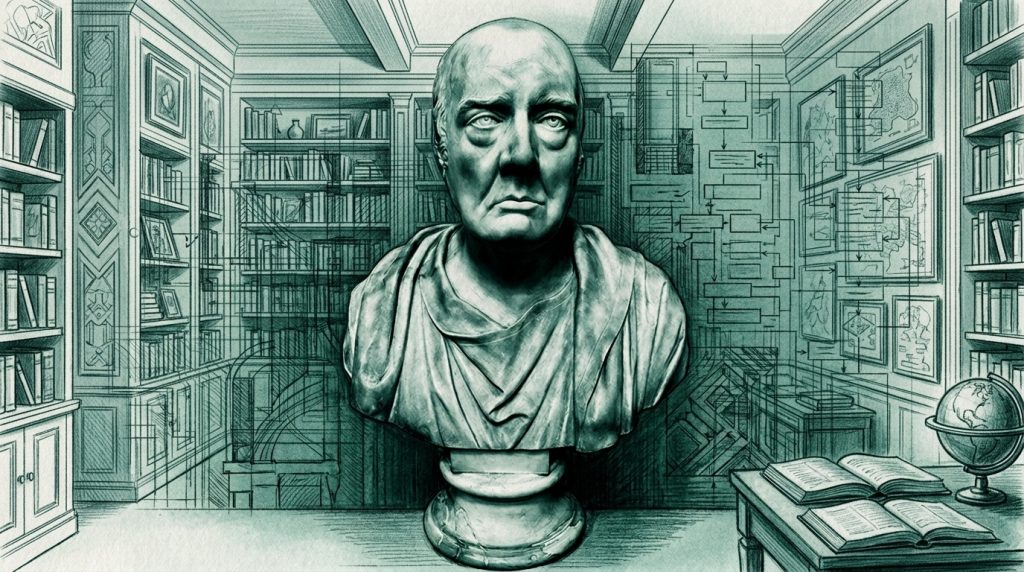
THE NUMBER: 222 — the years between the morning of July 11, 1804, when Aaron Burr shot Alexander Hamilton on the dueling grounds at Weehawken, and the May afternoon I sat in a stripped conference room on the 32nd floor of 120 Broadway signing a loan refinancing with a wet pen, a marble bust watching me from a shelf in the corner. Hamilton’s chair — most influential lawyer in New York, founder of The Bank of New York, architect of the United States financial system — stayed empty for five months after the duel. In November 1804 an exiled Irish revolutionary named Thomas Addis Emmet arrived in Manhattan and sat down in it. The firm’s own history page puts it in those exact words: Emmet filled “the void left by the death of Alexander Hamilton.” The firm he founded — Emmet, Marvin & Martin — then ran through the entire history of American capitalism. It argued Gibbons v. Ogden before John Marshall’s Supreme Court in 1824, establishing the principle of federal control over interstate commerce — the foundation of every regulatory framework in the Republic. And from 1921 to 1924 it was renamed Emmet, Marvin & Roosevelt — because Franklin Delano Roosevelt was a partner there before he left to become Governor of New York and then President of the United States four times. This morning I sat under that lineage in a half-empty office, signing paper documents in pen, and I did not recognize the bust on the shelf. I thought I was in a morgue. I didn’t realize I was sitting in the room where the institution era of American capitalism began. Hours later, the same Thursday, Zeb Evans — founder and CEO of ClickUp — published the playbook for ending it. Twenty-two percent of his staff are gone. The savings flow back to the survivors as million-dollar comp bands. He calls it the 100X organization. The 222-year roof Emmet built over Hamilton’s empty chair just came off.
The Bust in the Conference Room
I walked into the offices of Emmet, Marvin & Martin this morning to sign documents on a refinancing. Nine loans. Hundreds of signatures, every one in pen on paper. A title closer. Two paralegals. The kind of physical-document, wet-ink, walk-the-pages choreography that has been the language of New York real estate since the Astor era — and which, as we discovered Tuesday morning, the Astor real estate practice itself was once handled by this very firm.
The offices were dark. Not literally — the lights were on. But the life was off. The cubicles were empty. The art had been taken down. There were patches on the walls where pictures used to hang. The receptionist was a temp. The conference room I was led into had a single object on its sideboard — a marble bust of a man in a high collar with an Irish nose and a slightly raised chin, the kind of bust you walk past in the basement of a regional museum and never look twice at. I thought it was a Roman senator a name partner’s grandfather had bought at a Sotheby’s auction in 1958. I sat down with the loan documents and started signing.
The bust was Thomas Addis Emmet.
Born in Cork in 1764. Trained as a medical doctor at Edinburgh in 1784, then converted to barrister at Temple Inn in London. Successful Dublin barrister in the 1790s. Secretary of the Society of United Irishmen. Imprisoned for the failed 1798 Rebellion against British rule — and the firm’s own history page tells me, casually, like it’s a parenthetical, that if the rebellion had succeeded he would have been the first president of a free Ireland. His younger brother Robert Emmet led a second uprising in 1803, was caught, hanged, and beheaded. Thomas Addis Emmet was released from prison on condition of permanent exile, made his way to Paris, then to America, and landed in New York harbor in November 1804.
Hamilton had been dead for four months. Burr had been indicted for murder in New York, fled to South Carolina, finished his term as Vice President of the United States, and was already plotting the western treason that would land him in federal court three years later. The most prominent legal chair in New York City was empty. Emmet sat down in it.
The bust was Emmet because I was sitting in his firm. The conference room I was signing papers in was the legal descendant of Hamilton’s office, by direct unbroken transmission of inheritance, with the next-of-kin being a man whose life had been forged by a revolution that almost worked. This is the actual lineage of every law firm on Wall Street. It just happens that this one — the firm I happened to be in to sign a refi — keeps the receipts in marble.
I missed it. I walked past the bust. I sat down. I signed. I left.
I want you to understand what I missed, because the rest of this piece is about what every executive in America is currently missing in the same way, in their own building, this week, today. The institution we’re all working inside of has a 222-year history, and most of us cannot identify the bust in the lobby. And the institution is over.
The Roof
I want to walk you through what Emmet built, because if you don’t understand what he built you cannot understand what is dying.
In 1812, eight years after he arrived in New York, Emmet became Attorney General of the State of New York. He served through the War of 1812.
In 1824, twenty years after Hamilton’s death, Emmet stood before John Marshall‘s Supreme Court in Gibbons v. Ogden — on behalf of his client Aaron Ogden, a licensee of his friend Robert Fulton — and helped establish the principle of federal control over interstate commerce. This is one of the foundational opinions in American constitutional law. Every regulatory framework from the Interstate Commerce Commission to the SEC to the FCC traces its authority back to Gibbons v. Ogden. Emmet argued it from this firm.
In 1827 he was in court representing John Jacob Astor in a real estate case. Two days later, mid-trial, he collapsed in the courtroom and died. An advocate to the end, the firm’s history says.
In 1830 his sons, Thomas and Robert, helped charter the New York Life Insurance & Trust Company — which would merge into The Bank of New York in 1922. Emmet’s firm became BNY’s lawyers and stayed BNY’s lawyers for roughly a century, and lived as BNY’s tenant in their building at 48 Wall Street for sixty-three of those years (1928 to 1992). When you walked past 48 Wall in the 1970s, you walked past the office of the firm of the lawyer who had taken Hamilton’s chair.
In 1921, Franklin Delano Roosevelt, having just lost the Vice Presidential election on the Cox-Roosevelt ticket, came back to the firm where his old friend Langdon Marvin had become a partner. The firm’s name became Emmet, Marvin & Roosevelt for the next three years. Roosevelt left at the end of 1924 to run for Governor of New York. He won in 1928. He was elected President of the United States in 1932, 1936, 1940, and 1944. He prosecuted the Second World War from the chair he had been groomed for, in part, in the senior partner’s office of a firm whose founder had once been a fugitive from the British crown.
In 1934, President Roosevelt appointed Grenville T. Emmet Jr. — Thomas Addis Emmet’s great-grandson, still practicing law at the firm — as U.S. Minister to The Hague, and later to Austria.
In 1970, the last member of the Emmet family retired from the firm, ending one hundred and sixty-four years of continuous involvement of the descendants of the man who took Hamilton’s chair.
In 2001, the firm survived 9/11. Their offices were across Liberty Park from the World Trade Center. All staff safe and unharmed.
In 2005, Mayor Bloomberg declared May 12, 2005, Emmet, Marvin & Martin LLP Day in the City of New York.
In 2020, the firm renewed its lease at 120 Broadway, in the historic Equitable Building, for a new 15-year term. They moved there in 1992 because Emmet’s original office at 9 Nassau Street had been on the same city block. They came home.
The firm whose offices I sat in this afternoon, lights on but life off, refinancing nine loans by hand, has been continuously operating for two hundred and twenty-two years. It is older than the Erie Canal. It is older than the second French Empire. It outlasted the British Raj by seventy-nine years. It outlived the Tsars. It survived the Civil War, both World Wars, the Spanish Flu, the Great Depression, the Korean War, Vietnam, the Cold War, the 1987 crash, the dot-com crash, the September 11 attacks, the Global Financial Crisis, COVID, and the great resignation of 2022. It has a fifteen-year lease that expires in 2035, on the building they consider their ancestral home.
That is the roof Thomas Addis Emmet built over Alexander Hamilton’s empty chair. It lasted longer than most countries. Most empires. Most religions of the modern era.
And what AI has done in the last 24 months is take it off.
The Math
Tom Wolfe called the 1980s the Bonfire of the Vanities. He was wrong about the decade but he was right about the title — except the bonfire isn’t of the Masters of the Universe, it’s of the institutions the Masters of the Universe used to inhabit. And I want to give you the math because the math is what makes the institutions burn.
Consider the office I sat in this morning. The firm employed at its peak in the mid-2000s somewhere in the range of 90 to 130 lawyers and as many paralegals, associates, secretaries, and administrative staff. Call it 250 total seats. Within those 250 seats, on any given day, you would have had — by the standard distribution of any professional services firm in human history — a small number of truly extraordinary lawyers, a larger number of competent lawyers, and a long tail of adequate lawyers, paralegals, and support staff who showed up, did the work, and went home.
Imagine the productivity gap between the worst lawyer in the firm and the best lawyer in the firm. The folk wisdom is that the best lawyer is roughly ten times the productivity of the worst lawyer. A 10X ratio. That folk wisdom is roughly true. It has been true in every knowledge-work profession from the founding of the firm in 1804 until approximately 2024.
But the ratio is not the gap. The ratio is 10-to-1. The gap is from 1 to 10. The gap is nine points. Nine units of productivity, between the bottom and the top, in the firm. That gap is bearable on a P&L. You can pay the worst lawyer $200K and the best lawyer $2M and the math works. The best lawyer has structural reasons not to do the worst lawyer’s work — partnership track, billable hours, client meetings, court appearances. The worst lawyer has structural reasons to keep showing up — somebody has to read the documents, somebody has to file the motions, somebody has to be in the office Saturday morning when the closing is at 9 AM and the FedEx is late. Nine points of gap is what the institution era of American capitalism was structurally designed to absorb. Hierarchy was designed to absorb it. Tenure was designed to absorb it. Partnership tracks were designed to absorb it. Corporate ladders, MBA pipelines, the consulting up-or-out, the law firm two-track, the engineering IC level system, the Federal civil service GS scale — every institutional ladder in the American economy was designed for a 9-point productivity gap.
What AI did, between roughly January 2024 and today, is move the floor from 1 to 10, and the ceiling from 10 to 100. Same 10X ratio. Ten times the gap. From 9 points to 90 points.
Ninety points of gap is not bearable on a P&L. It cannot be hidden by hierarchy. It cannot be absorbed by tenure. It cannot be paid out by a partnership track. The lawyer at the top of the firm, now wielding Harvey and Claude for Legal and a discovery agent that reads ten million pages overnight, is no longer 10X the lawyer at the bottom. She is one hundred times that lawyer. The bottom lawyer using the same tools went from 1 to 2 — they don’t know how to ask the right question, they can’t decompose the right problem, they can’t verify the output. The top lawyer went from 10 to 100. The 9-point gap became a 98-point gap.
I’m being generous. The actual number is probably worse.
That is the math of the institution era ending. It is not that the workers at the bottom became worthless. It is that the gap between the bottom and the top became unbearable for the institutional structures that were built to hide it. And the moment the gap became unbearable, every executive in every knowledge-work company in America started doing the math in the same week.
Today — Thursday, May 21, 2026 — a CEO in San Diego published the answer.
The Announcement
Zeb Evans is the founder and CEO of ClickUp, a project-management software company last valued at approximately $4 billion. At roughly 1:00 PM Central Time today he posted a 1,400-word message on X. Read carefully it is the most important corporate communication of the year. I’m going to quote the parts that matter and tell you what they mean.
“Today we reduced headcount by 22%. The business is the strongest it’s ever been.”
Twenty-two percent. Not for cost reasons. Not because the company is in trouble. Not because of a market downturn. Because the business is the strongest it has ever been. This is the inverse of every layoff announcement in American corporate history. Layoffs used to be confessions of weakness. This is a layoff as expression of strength. The CEO is telling you that he is cutting more than one in five of his employees because the company is winning so hard he can no longer afford to be carrying them.
“I made this decision and I own it. I did it because the way to operate at the highest level of productivity is changing, and to win the future, ClickUp needs to change with it… This wasn’t about cutting costs. Most savings from this change will flow directly back into the people who stay. We’ll be introducing million-dollar salary bands. If you create outsized impact using AI, you’ll be paid outside of traditional bands.”
A million dollars in cash, per year, available to nearly anyone in the company who produces what Evans calls 100X impact. The savings from the 22% cut are not banked. They are not returned to shareholders. They are flowed back to the survivors as compensation. This is the public statement of the wage redistribution that has been happening privately at every AI-leveraged company for the last six months. The institutional structure that hid the productivity gap is being dismantled and the dollars are being repriced to the people who actually closed it.
Then Evans names the mechanism. This is the most important paragraph in his entire post and I want you to read it twice:
“The common narrative is that AI makes everyone more productive. It doesn’t. Many of the workflows of today, if left unchanged, create bottlenecks in AI systems… AI makes the best engineers wildly more productive, and everyone else using AI slows these engineers down.”
Read that last sentence again. Everyone else using AI slows these engineers down. The 1X engineer with Claude isn’t a 2X engineer. They are a negative drag on the 10X engineer, because the 10X engineer now has to spend her time reviewing the AI-slop of the 1X engineer’s output instead of directing her own agent. The 9-point gap became a 90-point gap and then it inverted at the bottom. The shelter the institution provided to the average performer didn’t just become unnecessary. It became a tax on the top performer. This is why the layoffs are not slow. This is why they don’t follow the LIFO conventions of corporate downsizing. This is why the CEO of a $4 billion company can cut 22% in a morning and call it strength.
Evans then quantifies it with data: “Companies doing this are celebrating 500% more pull requests. But customer outcomes don’t match the volume of code being generated. I call this the great reckoning of AI coding.”
Five hundred percent more pull requests, no improvement in customer outcomes. Volume is not velocity. More is the wrong vector when better is the only one that matters. The 1X engineers using Claude are producing five times the code at a fraction of the value because they cannot judge what is worth producing. The 10X engineer can. The institution used to make this distinction invisible by paying them out of the same band. AI made it visible. ClickUp’s CEO made it explicit. The other twenty thousand companies in the SaaS economy will follow this week or next.
This is not the announcement of a layoff. It is the announcement that the institution era of American capitalism is over. It happened on the same Thursday afternoon I was in Hamilton’s old chair, signing papers I didn’t know were the last papers, in a firm I didn’t know had a marble bust of an Irish revolutionary watching me.
The Duel Is Back
I want to be precise about what comes next, because the cleanest metaphor for the new economy is sitting on the trading desks of Chicago and South Florida, not in the law firms of lower Manhattan.
The old game was Survivor. I argued this Tuesday morning over coffee with a friend, who agreed and then sharpened it. The institution era was a tribal game. You won by social maneuvering. By alliance-building. By being voted into rather than out of the room. By understanding when to lay low and when to push forward in a partnership meeting. Richard Hatch won the first season of Survivor in 2000 by playing this game beautifully. He later went to federal prison for not paying taxes on the prize, which is its own small allegory for what happens to the social-game winners in the long run. But for the run of the show, the alliance-builder won. Bureaucracy was the immunity idol. Tenure was the alliance. Partnership track was the merge. Most knowledge workers in America were on the show, and most of them won by not actually doing the work.
The new game is Citadel. Ken Griffin runs roughly two hundred pods. Each portfolio manager gets a capital allocation — call it $100M to $500M. They keep 15 to 25 percent of the profits. They have a drawdown limit — hit eight percent and you are out. There is no partnership track. There is no we like you, you’ve been here twelve years. There is the P&L and there is the door. The top PMs at Citadel make $50M to $100M+ in a good year. The bad PMs disappear and Ken does not think about them again.
Substitute founder + AI for portfolio manager. Substitute compute budget and seed capital for capital allocation. Substitute next quarter’s customer growth for drawdown limit. Substitute equity for profit share. Substitute AI replaces you with someone who will compound for exit interview. That is the entire org chart of American knowledge work by 2028. Pod shop economics for white-collar labor.
And the actual mechanic, the mechanic Hamilton would have understood, is the duel.
I’ll admit something. Until I read the firm’s history page this afternoon I did not realize how literal this was. The Hamilton-Burr duel of July 11, 1804 was not a romantic confrontation in the cinema sense. It was the moment the social code of the early Republic broke down. Hamilton had said something about Burr at a dinner that found its way into print. Burr could not back down without losing standing. Hamilton could not apologize without losing his. They went to Weehawken because the institutional structure that was supposed to absorb their disagreement had failed. And so two of the most accomplished men in the country woke up at dawn and rowed across the Hudson and shot at each other from twenty paces. Hamilton died the next afternoon. Burr was indicted, fled south, finished his term as Vice President, was tried for treason in 1807, was acquitted, lived to 80 in obscurity. The institution-builders — Emmet first, the Bank of New York, the law firms, the trust companies — stepped into the void Hamilton left and built shelter so that the next 222 years wouldn’t require anyone to row across the river at dawn.
What AI has done is take the shelter off. The duel is back. Not as a romantic confrontation. As a workflow. You wake up. You direct your agents. You produce in a day what your competitor used to produce in a quarter. You win the customer or you lose the customer. There is no tribal council. There is no partnership vote. There is no committee. There is the P&L and there is the door. Win or die. Most CEOs in America have not yet realized this is the game they’re playing. Zeb Evans realized it this morning and published the announcement. The other ten thousand will publish theirs this quarter.
And here is the part that ought to make you sit up. My friend put it to me in an email this week, after he watched the same scene I’d describe to him later — two lawyers on a five-seat train section for seventy minutes, talking about how tough business was, complaining about Harvey eating their low end, narrating their own decline like commentators on a sport they used to play. Across from them, an investor was on Claude, learning about rocket launches because he was about to allocate to SpaceX’s June 12 IPO. The investor closed three trades worth $50 million each before lunch. My friend wrote:
“The future will be won by the builders, not the readers/talkers. Good example: On train today. In 5 seat section. Listened to 2 lawyers talk for 70 min about how tough biz is, etc, etc. no value created for them. Just whining/talking. I did work that generated 3 trades of $50M this am. I win. They lose.”
He’s not wrong. He’s not even being harsh. He’s describing the actual physics of the new economy from the inside of it. Three trades of $50M before noon while two lawyers — both presumably good at their jobs in 2018, both presumably making more than $500K a year, both presumably partners or near it at firms that have been in business for decades — narrated their own obsolescence to each other for seventy minutes without notice.
Seventy minutes of whining. Three trades of fifty million dollars. Same train. Different century.
The Three Exits
Here is the part of the piece where I owe you specific instructions, because every reader of CO/AI is in this story whether they realize it or not. You are either Zeb Evans (the CEO publishing the announcement), the survivor at ClickUp (the engineer about to make $1M cash), the laid-off engineer (one of the 22%), the lawyer on the train, the investor on Claude, the bust in the conference room, or — most likely — you have not yet figured out which one you are. I’m going to tell you the three exits, because Zeb Evans laid them out today and I want to repeat them in a register the COAI audience can act on.
Exit #1 — Build. The high-agency person who in 1995 would have spent nine years getting a Silicon Valley company off the ground now does it in ninety days. The barrier to starting a company is not lower than it has ever been. It is gone. Software is free if you can direct agents. Design is free if you can describe taste. Distribution is the only remaining moat, which is to say that founders with relationships, audiences, and trust — the Naval trifecta of capital, software, distribution — are now compounding at machine speed. Anthropic is five years old and is projecting its first profitable quarter this June — $10.9 billion in revenue, $559 million in operating profit, on track for a $900 billion valuation. The real estate broker on the street next to Emmet’s firm told me this week that a twenty-eight-year-old founder of a sub-three-year-old AI company had just taken seven thousand square feet for a new office, then asked to buy out the Alexander McQueen lease on the ground floor of the building so they could expand to thirty thousand. They needed desk space, not colleague space. The company is now valued at over a billion dollars. The chair Hamilton emptied in 1804 was empty for five months. The chair Anthropic is sitting in cost the entire institution era to build.
Exit #2 — Automate. Zeb Evans, in his post today, said the line that matters: “Ironically, the people that automate their jobs with AI will always have a job. They become owners of the AI systems — agent managers.” The role of the Agent Manager — the person who eats their own function with AI before someone else eats it for them — is the highest-leverage role inside any institution that still exists. It is also exactly the role I’ve been sketching with my own partner over the last 72 hours: an outsider AI audit business. Going into companies as the outside firm that identifies where AI is going to break their org chart, where the bottleneck is going to form, and how to redistribute the work so the 100X people don’t drown in the slop of the 1X people. The audit is the most defensible business model in the next five years because no one inside a company can do it. It is too politically dangerous. It is too close to the bone. It requires somebody from outside to tell the CEO that 22% of the staff are net negative drag. If you are not yet ready to leave your job to build, this is the role to take inside your current company. It also happens to be one of the few roles that ages well as the technology improves. As the agents get better, the value of the person who can direct them goes up, not down. Every other role in the company is the inverse.
Exit #3 — Touch. Evans’s third role is the front-liner. He is unambiguous in his post about this: “In a world that will become saturated with AI communication, the human touch will matter more than anything to customers. This is a bottleneck that you shouldn’t replace — even when agents are high enough quality to do video meetings.” The customer-facing meeting is the last bottleneck Zeb Evans says he will deliberately preserve. This is why the BMS-Anthropic deployment we covered today — Bristol-Myers Squibb’s rollout of Claude to 30,000 employees across research, clinical, manufacturing, commercial, and corporate — specifically preserves the field rep, the clinical investigator, and the regulatory submission lead. The pharma company is automating the documentation, not the conversation. Distribution remains a moat — for now. The sales rep with a real relationship with the FDA reviewer is not going to be replaced by an agent in 2026. The sales rep who has been sending generic LinkedIn intro emails might already be.
Build. Automate. Touch. Three exits. Anything else is the morgue.
What This Means For You
You are reading this on Thursday evening, May 21, 2026, in a building you walk into most days. There is probably a bust or a plaque or a portrait of the founder somewhere in your lobby. You probably do not know who it is. The institution you work inside of has a history you’ve never read. It was built to absorb the productivity gap between the worst and the best, on the assumption that the gap could not get any wider than 9 points. The gap is now 90 and rising. The roof that was built for the smaller gap is coming off.
You have three weeks, maybe four, to decide whether you are in Exit #1, Exit #2, or Exit #3. Not three years. Not three quarters. Three weeks, because Zeb Evans published the playbook today and the next 50 CEOs will publish their versions before Memorial Day. The wages saved from the 22% cuts will flow to the 78% who stay. The salary bands at the top will be repriced. The salary bands at the bottom will be deleted. If you are in the middle, the middle is being abolished. You will be moved up or moved out. There is no third option. The 9-point gap was the third option and it is closed.
Three questions to ask yourself this weekend:
1. If my employer announced a 22% cut tomorrow, would I be in the 78% or the 22%? Be honest. Do not look at your tenure. Do not look at your title. Look at the dollar value of what you produced last quarter relative to the cost of producing it. If you are net positive at 100X leverage, you are safe. If you are net positive at 1X leverage in a building where AI has arrived, you are at risk. If you are net negative — if you are the person whose work the 100X person now has to review and clean up — you are gone.
2. Which of the three exits do I have the agency to take? Build is for founders. Automate is for the operator who can be the AI Manager inside a still-functioning company. Touch is for the relationship-holder whose distribution is the moat. Pick one and start moving this week. The optionality of staying ambiguous is also being abolished.
3. What is the bust in my lobby? Not metaphorically. Literally. Walk in tomorrow morning and look at it. Read the plaque. Google the name. Find out what was built on the floor you walk through every day. Because if you don’t know what the institution era looked like at its founding, you cannot recognize that it is ending around you. Hamilton died at 49 in a duel he didn’t have to fight. Emmet built a 222-year firm in his place. This morning I sat in that firm signing papers under his bust without knowing whose firm I was in. That is the posture of the entire American knowledge-work economy this week. Do not be that posture.
The Compounders’ Day in the Data
A quick scan of today’s other signals, all of which braid into Emmet’s roof and Evans’s playbook:
- Anthropic Q2 nearly profitable — projected $10.9B revenue, $559M operating profit, first profitable quarter in the company’s 5-year history. Anthropic = Exit #1 compounding at full speed.
- Bristol-Myers Squibb deploys Claude to 30,000 employees — first major pharma agentic rollout. 30,000 BMS employees just had their shelter removed simultaneously. The CEO of BMS just executed an Exit #2 at Fortune-100 scale.
- Hark $700M Series A at $6B — Brett Adcock’s second company in three years. Personal AI hardware bet. Phones and laptops are not the final interface. Exit #1 archetype: serial builder, multiple shots at the frontier.
- Modal $355M Series C at $4.65B — agent-cloud infrastructure. The picks-and-shovels of the new game.
- OpenAI’s reasoning model autonomously disproved an 80-year-old Erdős conjecture — verified by Fields Medalist Tim Gowers. The AI itself just demonstrated Exit #1. The 100X mathematician is not a person. It’s a model.
- Codex Goal Mode + locked Mac control — OpenAI’s agent now works while you sleep. The Citadel pod that never closes for the night.
- Meta layoff drama — Meta tracked elite engineers, trained AI on the monitoring data, then cut the engineers. The dark mirror of ClickUp’s announcement: same redistribution mechanic, executed without the moral cover. Both are real. Both are happening this week.
- Anthropic-SpaceX rental — $45B over three years, extended to Colossus II in Mississippi. Yesterday’s Musical Chairs gets sharper today: the rent line is paid, the chair is rented, the music has not stopped.
- Newsom signs first US state-level AI labor displacement executive order — California will study subsidies for companies that don’t replace workers with AI. The political-economy response is starting. The 22% who got cut at ClickUp will vote.
Every one of these stories is the same story. The roof Emmet built is coming off. The companies that get to the new game first will compound at machine speed. The companies that try to iterate on the old structure will be in the morgue by Q3.
The Closer
I want to give you the last word of the piece in the words of two men I respect.
The first is a friend who closed three $50M trades while two lawyers narrated their own obsolescence to each other on the train this Tuesday. He wrote me later:
“The future will be won by the builders, not the readers/talkers… I did work that generated 3 trades of $50M this am. I win. They lose.”
The second is the man whose firm I sat in this morning, Thomas Addis Emmet, who would have been the first president of a free Ireland if the rebellion had succeeded and instead became the leading lawyer in New York City after Alexander Hamilton was killed at Weehawken. He died collapsing in court mid-trial in 1827, advocating to the end. He didn’t die behind a desk. He didn’t die on a partnership track. He died in the arena, doing the work, on his feet, in front of a judge. He was high agency until the last sentence he spoke.
The institution he founded lasted 222 years. The institution that succeeded him hosted FDR. The institution that succeeded that one argued Gibbons v. Ogden. The institution Harry walked into this morning was the same institution, on its last lease, with the bust on the shelf and the lights on but the life off.
The roof Emmet built lasted until this week. The CEO who announced its end this morning will be one of ten thousand by Memorial Day. By the end of June you will be either in one of three exits or you will be the lawyer on the train. There is no fourth choice. The 9-point gap is closed. The shelter is gone. The middle is being abolished. The duel is back.
In my own words, to close:
AI exposes capitalism. AI exposes agency. AI exposes a willingness to bet on yourself, on your own intellect, on solving problems. You want to just live out your life and pay your bills?
You are dead.
Pick a song. Pick an exit. The five-seat train car is the room where it happens.
Signal/Noise by CO/AI is researched, written, and edited daily by Harry DeMott and Anthony Batt. To respond, reply directly to this email — we read everything.
Harry & Anthony
Past Briefings
Musical Chairs
THE NUMBER: $1.25 billion — Anthropic's rent line to xAI for compute. Per month. The detail emerged today inside SpaceX's S-1 filing with the SEC, ahead of the company's June 12 IPO. Anthropic will pay $1.25B every month through May 2029 for the entire 300-megawatt output of Colossus 1 in Memphis — roughly $40 billion in total commitments. Either side can terminate on 90 days' notice. xAI overbuilt; Grok usage has dropped; Anthropic absorbs the slack. That's the rent line for one (1) frontier lab. Not the salary line. Not the talent line. Not the chip purchase. Rent. It is,...
May 20, 2026The Right Stuff
Chuck Yeager broke Mach 1 with two cracked ribs and a sawed-off broom handle taped to his right arm. Andrej Karpathy quit a running company on Tuesday morning to take an individual-contributor research role. Six CTOs went before him. Anthropic's Mercury Seven is complete. The only question left is whether you have it too. THE NUMBER: 7 — the Mercury Seven, announced by NASA on April 9, 1959, after a brutal six-month winnowing of 110 of America's best military test pilots. Scott Carpenter, Gordon Cooper, John Glenn, Gus Grissom, Wally Schirra, Alan Shepard, Deke Slayton — seven names that became...
May 18, 2026Days Of Thunder
THE NUMBER: 29 — the years between January 1882, when John D. Rockefeller signed the Standard Oil Trust agreement that consolidated forty companies under his control of roughly 90 percent of American oil refining, and May 15, 1911, when the United States Supreme Court ruled in Standard Oil Co. of New Jersey v. United States and broke the trust apart. One hundred and fifteen years and three days after that ruling, on Monday May 18, 2026, a nine-member federal jury in California needed less than two hours to dismiss Elon Musk's $134 billion case against OpenAI and Sam Altman —...