
Harvard researchers study how to communicate with whales
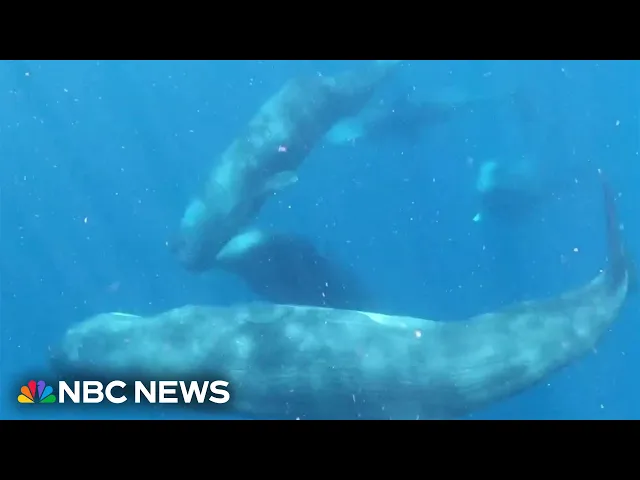
Speaking whale: scientists' breakthrough with marine giants
In a world where interspecies communication often seems like science fiction, a team of Harvard researchers is turning fantasy into reality. The groundbreaking Cetacean Translation Initiative (CETI) is applying cutting-edge artificial intelligence to crack the code of sperm whale communication, potentially opening a portal to understanding non-human intelligence in ways previously unimaginable.
Key Points
- CETI researchers are recording and analyzing millions of sperm whale vocalizations (clicks called "codas") using machine learning to identify patterns and potentially decode their communication system
- The project combines expertise from diverse fields including marine biology, linguistics, robotics, and AI to create new paradigms for understanding non-human intelligence
- Beyond scientific discovery, the research has profound ethical implications about our responsibility toward other intelligent species and could reshape conservation efforts
The AI Breakthrough in Cetacean Communication
The most fascinating aspect of CETI's work lies in how they're leveraging advances in machine learning to tackle what was previously an insurmountable challenge. Traditional approaches to animal communication studies have been limited by human processing capabilities and preconceptions. Now, AI systems can identify patterns in vast datasets of whale vocalizations without those limitations.
This matters tremendously in our current technological moment. As we develop increasingly sophisticated AI systems and debate the nature of intelligence itself, understanding non-human cognition provides a critical alternative perspective. Whales, with their massive brains and complex social structures, offer a fascinating case study of intelligence that evolved completely independently from our own, shaped by the ocean environment rather than terrestrial challenges.
The implications extend far beyond academic interest. If we can establish meaningful communication with another species, it fundamentally transforms our ethical relationship with them. We move from seeing animals as resources to recognizing them as entities with their own internal lives, social structures, and potentially rights. This shift could revolutionize conservation efforts, moving from preservation based on environmental benefit to protection based on recognizing the intrinsic value of non-human intelligence.
Beyond the Research
What the Harvard team hasn't fully explored is how this research intersects with indigenous knowledge systems. Many coastal indigenous cultures worldwide have claimed deep communication and relationship with whales for centuries. The Tlingit people of the Pacific Northwest, for instance, have traditions describing communication with orcas that science has long dismisse
Recent Videos
Andrej Karpathy on the Decade of Agents, the Limits of RL, and Why Education Is His Next Mission
A summary of key takeaways from Andrej Karpathy's conversation with Dwarkesh Patel In a wide-ranging conversation with Dwarkesh Patel, Andrej Karpathy — former head of AI at Tesla, founding member of OpenAI, and creator of some of the most popular AI educational content on the internet — shared his views on where AI is headed, what's still broken, and why he's now pouring his energy into education. Here are the key takeaways. "It's the Decade of Agents, Not the Year of Agents" Karpathy's now-famous quote is a direct pushback on industry hype. Early agents like Claude Code and Codex are...
Oct 6, 2025How To Earn MONEY With Images (No Bullsh*t)
Smart earnings from your image collection In today's digital economy, passive income streams have become increasingly accessible to creators with various skill sets. A recent YouTube video cuts through the hype to explore legitimate ways photographers, designers, and even casual smartphone users can monetize their image collections. The strategies outlined don't rely on unrealistic promises or complicated schemes—instead, they focus on established marketplaces with proven revenue potential for image creators. Key Points Stock photography platforms like Shutterstock, Adobe Stock, and Getty Images remain viable income sources when you understand their specific requirements and optimize your submissions accordingly. Specialized marketplaces focusing...
Oct 3, 2025New SHAPE SHIFTING AI Robot Is Freaking People Out
Liquid robots will change everything In the quiet labs of Carnegie Mellon University, scientists have created something that feels plucked from science fiction—a magnetic slime robot that can transform between liquid and solid states, slipping through tight spaces before reassembling on the other side. This technology, showcased in a recent YouTube video, represents a significant leap beyond traditional robotics into a realm where machines mimic not just animal movements, but their fundamental physical properties. While the internet might be buzzing with dystopian concerns about "shape-shifting terminators," the reality offers far more promising applications that could revolutionize medicine, rescue operations, and...